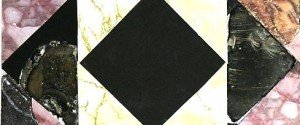
2000 year old marble floor tiles from the Holy Temple on Mount Moriah in Jerusalem brought to light.
Marble floor tile from Holy Temple Jerusalem (credit Zachi Dvira Temple Mount Sifting Project)
For the first time in history, actual decorative elements from the Holy Temple in Jerusalem have been brought to light! Exquisite marble floor tiles, made with meticulously cut stones of different colors – yellow, black, red, purple, white, and more have been recently recovered and pieced together, giving us insight into the great beauty of the Holy Temple of the Jews that stood on Mount Moriah and was destroyed by Titus the Roman in the year 70 AD. Archaeologists have so far been able to identify seven distinct floor tile patterns.
Marble floor tile from Holy Temple Jerusalem (credit Zachi Dvira)
We read about the impressive Temple floor tiles in various literary sources: Josephus Flavius, the Jewish historian who actually served as a priest in the Jerusalem Temple wrote (Jewish Wars V,5,2), “Open courts were laid with stones of various colors.” In the Babylonian Talmud (Baba Bathra 4a) we read, “It used to be said, He who has not seen the Temple of Herod [in Jerusalem] as never seen a beautiful building. Of what did he build it? Rabbah said: Of yellow and white marble. Some say, of blue, yellow, and white marble.”
Marble floor tile from Holy Temple Jerusalem (credit Zachi Dvira)
Hundreds of colorful marble floor tile pieces have been discovered in a major sifting project undertaken by Israel Antiquities authority after Moslem religious authorities on the Temple Mount (where the golden dome Mosque of Omar and El Aksa mosques are located) illegally removed rubble beneath Mount Moriah, without conducting a proper archaeological excavation. The floor tiles were probably part of the monumental subterranean passageway built by Herod the Great that led up to the Courtyard of the Gentiles on the Temple Mount, and was used by pilgrims – such as Jesus, Mary, & Joseph – when they came to Jerusalem for Passover.
Visit Israel & see remains of the Holy Temple in Jerusalem
I invite you to join me here in Israel and experience a 3-D living color Bible- a blessing without measure! We’ll learn about the Holy Temple that stood on Mount Moriah, visit the Temple Mount excavations, and even help wash the archaeological remains in search of artifacts.
Why “stone” water jars at the wedding in Cana of Galilee?
Travelling from Nazareth to the Sea of Galilee we pass through Cana in Galilee where according to the New Testament Scriptures Jesus changed six “stone” jars of water to wine at the wedding. What did they actually LOOK like and WHY does the Bible stipulate they were made out of “stone” rather than the usual clay pottery?
Stone water jars
Mention in John 2:1-6
Dear friends, Many of heard about biblical stone water jars, but how many of actually SEEN one? We read about them in the New Testament in connection to a Jewish wedding in Cana where Jesus changes water to wine: “On the third day a wedding took place at Cana in Galilee… Nearby stood six stone water jars, the kind used by the Jews for ceremonial washing, each holding from twenty to thirty gallons.” (John 2:1-6).
Biblical stone water jar discovered
Well, here’s the real McCoy, discovered in an excavation, some 15 feet below the Jewish Quarter in the Old City of Jerusalem. The stone water jar was carved and polished by hand out of one chunk of limestone and stood inside a 7500 sq. foot palatial home and probably belonged to a wealthy Cohen (priestly) Jewish family who lived in Jerusalem at the time of Jesus – when the Temple was still standing.
Why made out of stone? In Lev. 11:36 we read: “Only a spring and a [stone] pit… shall be clean”. In other words, only a stone water container is “clean” and doesn’t become ritually impure if it comes in contact with death (for example if a mouse is found dead in it):
Problem of ritual impurity
If on the other hand the water container was made of ceramic (rather than stone) it could be rendered ritually impure, as would the water itself AND the priest that used it! This was no small matter, for in such a state of ritual impurity a priest (such as Zachariah, father of John the Baptist) couldn’t serve in the Jerusalem Temple or eat of the holy sacrifices and offerings that pilgrims brought!
Wedding hall where all could partake & celebrate
So getting back to the story of the “six stone water jars” mentioned in John 2, if you were a wedding hall owner in Galilee 2000 years ago and wanted your clients to be able to invite their priest friends to the reception, you’d invest in a set of expensive stone vessels (rather than cheaper ceramic). Of course it would cost more, but hey, one doesn’t get married everyday (hopefully) and you’d want your wedding reception clients to be able to invite all of their friends.
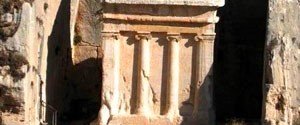
Walking in the Kidron Valley at the foot of the Mount of Olives in Jerusalem we come across the monumental rock carved Tomb of Zechariah son of Jehoiada the High Priest.
Tomb of Zechariah son of Jehoiada the High Priest who served in Solomon’s Temple in Jerusalem
Zechariah murdered:
Zechariah the priest, who lived in Jerusalem at the end of the 9th century BC, dared admonish Joash, king of Judah, for being unfaithful to YHWH and allowing Baal worship to be reintroduced into the Holy Temple in Jerusalem.
Actually, Joash in the early part of his 40 year reign instituted a wide religious reform, ridding the Temple of Baal worship, but later on lapsed into idolatry. Zechariah the priest spoke out against this and was subsequently murdered by stoning in the courtyard of the Temple of Solomon. We read about it in 2 Chronicles 24:21ff:
Here’s what the Bible’s got to say: “Then the Spirit of God came on Zechariah son of Jehoiada the priest. He stood before the people and said, “This is what God says: ‘Why do you disobey the Lord’s commands? You will not prosper. Because you have forsaken the Lord, he has forsaken you. But they plotted against him, and by order of the king [Joash] they stoned him to death in the courtyard of the Lord’s temple.”
Joash had been saved as an infant by Zechariah’s father Jehoiada: King Joash apparently did not remember, or did not want to remember, the kindness Zechariah’s father – Jehoiada the High Priest – had shown him when he was an infant: Jehoiada saved Joash from his evil grandmother, Athaliah, daughter of of Ahab and Jezebel: After her son Ahaziah, king of Judea, was killed at Megiddo, she began killing her dead son’s children to assure her position as ruler over Judea! When Joash turned seven, Jehoiada the High Priest brought him out of hiding as the legitimate heir to the throne, descendant of the House of David, and anointed him king over Judea (see II Chronicles 22:11 & II Chronicles 24:21).
Egyptian influence
The the monumental rock carved tomb is from the 2nd century BC and has a pyramid shape, showing Egyptian influence.
Leaving Jerusalem, we follow the main road to Emmaus, a biblical Jewish town that became known as Nicopolis in the late Roman Byzantine period. Here passed Joshua, the Maccabees, Crusades, & Jesus who, according to the New Testament Book of Luke, appeared after Calvary and the Resurrection.
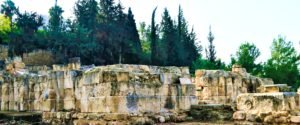
Emmaus: Byzantine & Crusader church
A real biblical place…
The rich history of Emmaus is marked by the passage of many conquerors and famous people. The Book of Joshua tells how the sun and moon stood still over the adjacent Ayalon Valley when Joshua marched with the Israelites on Gibeon- north of Jerusalem – some 3200 years ago. In 165 BC, Judah Maccabee, one of the important heroes of Hanukkah, won an important victory nearby against the Greek troops of Nicanor. This opened the way to Jerusalem and made it possible for the Jews to purify the Temple which had been desecrated by the Greeks and re-establish the Divine Service, a victory celebrated by the feast of Hannukah every year.
The place where Jesus broke bread
By the time of Jesus’ public ministry (~30 AD) Emmaus had become a simple village. It was here, after the Resurrection, that Jesus appears to his disciples, who recognized Him in the breaking of bread (Lk. 24:13-35).
Byzantine period: Christian pilgrimage
In the 3rd century AD there was a Christian community in Emmaus and the town was given a new name, Nicopolis or City of Nike – Greek goddess of victory. During the Byzantine period (4-7 centuries) Emmaus Nicopolis became an important Christian administrative center and a basilica to serve Christian pilgrims was built at the traditional site of Jesus’ apparition.
Crusades
Byzantine churches which had earlier been destroyed were built by the Crusaders in the 12th century, and subsequently destroyed after the Arab reconquest of the Holy Land. Impressive remains are still visible.
Modern times
It was only in 1878, at the initiative of Miriam of Bethlehem, that the Carmelite convent of Bethlehem acquired the site. Since then, it has once again become a place of pilgrimage.
Excavations
Excavations in 1880, 1924, and recent years unearthed the remains of two imposing Byzantine basilicas with beautiful mosaics, a baptistery, and the ruins of a Crusader church.
Gospel according to Luke 24,13-35
“That very day two of them were going to a village named Emmaus, about a hundred and sixty stadia from Jerusalem, and talking with each other about all these things that had happened. While they were talking and discussing together, Jesus himself drew near and went with them. But their eyes were kept from recognizing him… So he went in to stay with them. When he was at table with them, he took the bread and blessed, and broke it, and gave it to them. And their eyes were opened and they recognized him; and he vanished out of their sight…”
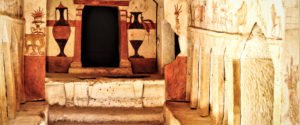
The Sidonian Tomb discovered at the biblical city of Beit Guvrin – Maresha in the foothills of Judea southwest of Jerusalem, is an extraordinary rock-carved and hand-painted burial complex. It belonged to Phoenician traders from Sidon that settled in southern Judea after Alexander the Great’s conquests (332 BC).
Sidonian tomb
Explore a biblical city…
There aren’t remains of too many ancient cities that one can wander through and see how people lived over 2000 years ago! Well, Beit Guvrin / Maresha, situated in the foot hills of Judea is one of them. Today we explore the colorful mausoleum of a wealthy family of traders that came from Sidon (Lebanon today) and settled here in the 2-3rd century BC.
Why situated here?
Situated at the foot of the Judean Hills, between the Mediterranean coast and the mountains, Maresha was on an important trade route connecting Hebron and the port city of Ashkelon.
Greek speaking settlers from Sidon
Sidon was and still is an important seaport- just north of Israel, on the Lebanon coast. In bible times it was home to Phonecian traders that plied the Mediterranean establishing trading posts as far away as Spain and the Atlantic Ocean. They also settled here. From the time of Alexander the Great (3rd C. BCE) it became Greek speaking and as pagans they worshipped the Greek gods.
Burial caves with colorful paintings
The soft local chalk allowed the locals at Maresha to carve out extensive subterranean tombs and even underground workshops. The colorful wall paintings depict, plants and animals from everyday life such as a lion, snake, fox while some of them are mythological. Musicians accompany the funeral train. They are short, pudgy, and appear to be somewhat jovial types. One of the instruments is a double reed flute that can still be found in the region. A loving and kind person
Apollophanes: Leader of the local Sidonian community
In the tomb depicted here archaeologists found an inscription mentioning the wealthy head of the local Sidonian community buried here. His name was Apolophanes son of Sesmaios, leader of the Sidonian community in Maresha. On a human note, the inscription goes on to say that Apolphanes was a kind, loving, generous, and well liked person. And here we are remembering him over 2000 years later! A name and memory worth more than a person’s weight in gold – can anyone wish for more?
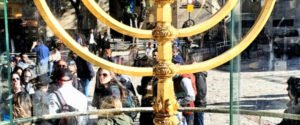
The seven branch Menorah or Golden Lampstand, a reminder of the seven days of Creation, was cast from one talent of gold and stood in the Tabernacle of Moses and later in Solomon’s Temple in Jerusalem.
Golden Menorah
Divinely inspired
Did you know that the Menorah or Golden Lampstand, as it is translated in many Bibles, was specially designed by God? It’s a “divine design” by the Master Creator of the universe and, following God’s instructions detailed in the Bible (Exodus 25:31-40). It had seven branches and was cast in one piece using 1 talent of pure gold: “Make a lampstand of pure gold. Hammer out its base and shaft, and make its flowerlike cups, buds and blossoms of one piece with them… A talent of pure gold is to be used for the lampstand and all these accessories.”
Where was the Menorah placed?
God proscribed that it should be placed in the Tabernacle – the portable temple – that the Israelites carried through the wilderness for 40 years, on the way from Egypt to the Promised Land. Later on it was places in the Holy Temple that king Solomon built on Mount Moriah in Jerusalem (“Solomon’s Temple”). Throughout history the Jewish people have incorporated it into synagogue design and today it is the symbol of the modern state of Israel- it’s that important! Let’s look at the meaning of the word Menorah. In most bibles it is translated as Golden Candlestick or Candelabrum. What is so special about it? Why is it holy and what does it represent?
How much is one talent of gold?
One talent (kikar in Hebrew) is worth 3000 shekels. There are various evaluations of how much a shekel weighs, but if we take an average of 12 grams/ shekel X 3000 = 3.6 kilos. At a gold value of $1,108 per troy ounce = approximately $128,000!
Why the number seven?
The seven branches or lights are not by coincidence. In the Bible, the number seven reminds us of the seven days of creation in the biblical book of Genesis. Seven in Hebrew- sheva – means fullness- to be totally filled and fulfilled. It was indeed what God felt when he finished his masterwork of Creation and His jewel-in-the- crown: Us! And then he “rested” on the seventh day- i.e. kicked back and said “Wow!”. He had humanity to lavish his love upon, with the hope, since we were created in His image, that we’d turn around and to the same with each other in fulfilling the commandment “love your neighbor as yourself”.
What is the significance of the lights?
The name “menorah” comes from the Hebrew root meaning “light” . So the emphasis is not on the actual candle holder but on the subject of “light” within the biblical creation story of the seven days. Indeed, the first thing God did – on the 1st day was to create light- “Let there be light!”. What kind of light was it? Not necessarily a physical light, but more importantly the Divine Light – which increased day by day throughout the Creation story as God planted himself in every nook and cranny of Creation- until it was All Pervading- as represented by the Menorah. But God’s menorah is not candles or oil lamps- it is people. Indeed in the book of Proverbs it says, “The spark, the lamp, of God (i.e. the divine light) is the soul of man.”. In other words, we, each human being, is a divine light, carrying the divine spark that was created on the 1st day. Through our actions we can choose to increase the divine light within ourselves or diminish it. The choice is ours, in the way we conduct our daily lives.
What happened to the original Menorah?
When Titus burned down the Holy Temple in Jerusalem he looted it and removed the Golden Lampstand. It was then paraded through the streets of Rome along with Jewish prisoners of war as depicted on the Arch of Titus near the Colosseum in Rome. His father Vespasian deposited the Menorah together with the other booty in the special temple which he erected after the Jewish Revolt against Rome in the years 66-73 AD. (Josephus Flavius: Wars 1:148-50) The subsequent fate of the Golden Lampstand is uncertain. It was probably melted down since it was made with 1 talent (3.6 kg) of pure gold.
Stand at Armageddon (Revelations 16:16) overlooking the Valley of Jezreel (Hosea 1:4), and place of Ezekiel’s End of Days war of Gog and Magog. Here is the crossroads of the world where three intercontinental highways converge- from Europe, Asia, and Africa.
Valley of Armageddon
Valley of Armageddon
We are standing atop the biblical mound of Megiddo, one of the most important cities in Bible times, looking out over the Jezreel Valley, also known as Armageddon in the New Testament. The name Armageddon is a Hebrew word that literally means “Hill of Megiddo”. We read about it in Revelations – the last book of the New Testament with regard to the End of Days war: “And I gathered them [the nations] unto a place known in the Hebrew tongue as Armageddon” (Rev. 16:16)
War of God & Magog
This End of Days battle is also alluded to in the Gog and Magog war described in Ezekiel (38:3-23): “Thus said the Lord: Behold, I am against you, Gog, the prince… I will summon a sword against Gog on all my mountains… I will execute judgment on him with plague and bloodshed; I will pour down torrents of rain, hailstones and burning sulfur on him and on his troops and on the many nations with him. And so I will show my greatness and my holiness, and I will make myself known in the sight of many nations. Then they will know that I am the Lord.’.
Book of Revelations
In Revelations 20:7 we read more on the End of Days battle: “When the thousand years are finished, Satan shall be loosed out of his prison, and shall come forth to deceive the nations which are in the four corners of the earth, Gog and Magog, to gather them together to the war.”
Crossroads of the world
So why did this place – Armageddon – take on an association with an End of Days war? The answer lies in the geography of the area. Three intercontinental roads converge here in the valley, from Europe, Asia, and Africa. And for that reason all the great conquerors of antiquity have passed this way: Alexander the Great from the north (Greece), Nebuchadnezzer from the east (Babylon), and the pharaoh Thutmoses III from the south (Egypt). Another interesting point- it’s pretty much equal distance from this spot to the some of the world’s most strategic capital cities: Madrid, Paris, Moscow, Bombay, and Nairobi!!!
Why is it also called Jezreel?
The name Jezreel – Yizra’el in Hebrew- means “God will sow”. As the largest and most fertile valley of the country, it was in bible times the bread basket of the country. The significance of the name, and nature of the area as prime farm land, raises the biblical question, “who” will sow the seed and provide grain, the staff of life: The God of love and justice that that lives within us, or the pagan stone gods? Indeed, on nearby Mount Carmel, Elijah called the people to decide who is the true provider- Yahweh or Ba’al (Canaanite equivalent of Zeus or Jupiter). In the Bible God warns the people that if they follow the pagan gods he will bring drought upon the land, there will be no rain, and then of course no wheat, as it is a rain dependent crop, not an irrigated one.
Jezreel son of Gomer the harlot
Jezreel is also the name of the prophet Hosea’s son from the harlot Gomer whom he married (Hosea 1:3-4). God asked Hosea (8th century BC) to marry a harlot in order to demonstrate what real devotion and love is. Such was the love and devotion of Yahweh to his people, in spite of their behavior as harlots, chasing the skirts of the pagan gods.
Touch biblical Jerusalem! Israel’s Western Wall or Wailing Wall, built by King Herod, supports the huge Temple Mount platform over Mount Moriah where Solomon’s Temple stood. Ask Zack Shavin about visiting and even celebrating your Bar Mitzvah or Bat Mitzvah there!
Biblical Jerusalem
Imagine a piece of ancient Jerusalem, so authentic, so well preserved, that what you see today is exactly what was seen by the local people and tens of thousands of Passover pilgrims that made their way up to the great Holy Temple 2000 years ago! It is called in Hebrew the Kotel Ma-aravi or Western Wall, and is a perfectly preserved remnant of the massive outer retainer walls that encompassed the Temple itself. Originally over 1500 feet long and 100 feet high, the Western Wall was one of four incredibly massive walls that not only protected the Temple, but also supported a massive platform which covered an area equivalent to 15 football fields and upon which the 200 foot high marble and gold Temple stood.
Wasn’t the Temple destroyed by the Romans?
Indeed, the Temple building itself – considered one of the wonders of the ancient world – was destroyed by the Romans in the year 70 A.D. But the platform upon which the Temple stood, covering an area of 15 football fields, and the outer retainer walls, were preserved. It was just too massive to totally demolish. The smallest of the stones in the Western Wall weigh 3 tons each, the largest about 500 tons- as much as 10 fully loaded semi-trailer trucks!
Why do we pray at the Western Wall? Why this spot?
It is important to understand, that this place is Mount Moriahitself, where Abraham brought Isaac, almost 4000 years ago. About 1000 years after Abraham, King Solomon was given the privilege of building the Temple here, permanently replacing the desert Tabernacle. The Bible tells us that upon completing the Temple, ruach elohim- the spirit of God- filled the House. Otherwise it would have remained just a beautiful man-made building.
Shekinah: Divine Presence
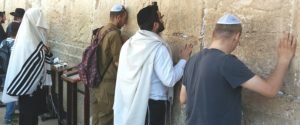
In other words, the Shekinah- the Divine Presence- is intimately associated with the area. Indeed, the Temple is called “Beit HaMikdash” in Hebrew, which means “House of Holiness”. God is pure holiness; divine holiness came to rest here. God, Yahweh- HaShem- chose this place- it is unique in all the world! Two thousand years ago Jewish people prayed at the Temple itself. Today, the gold-domed Mosque of Omar stands over the spot and is closed to non-Moslems for prayer purposes. While we cannot pray on the Temple Mount itself, we can do so at the Western Wall. There we literally touch a remnant of the Temple complex and connect with our roots, faith, and heritage.
Visit Masada, a mountaintop fortress overlooking the Dead Sea built by King Herod of Judea: Palaces, Roman baths, food storerooms, and impressive waterworks. See remains of the Roman army & Tenth Roman Legion Fretensis: In 73 AD the Romans spent six months to to defeat less than one thousand Jewish zealot freedom fighters.
Masada
Masada’s got it all!
Great archaeology, dramatic setting, and a powerful story! Out in the middle of the mountainous Judean desert, hanging on the edge of a cliff over 1500′ (450 meters) above the valley floor overlooking the Dead Sea.
What does Masada mean?
Masada keeps to its name. It means “fortress” in Hebrew and it is the ultimate palace-fortress complex with two palaces, Roman baths, food warehouses, synagogue, and even a swimming pool! And all of this in one of the driest areas of Israel that receives only 50 mm (2 inches) of rain a year! How did the builders over 2000 years ago do it?
Who built Masada?
Now that’s a very good question. It was built by none other than King Herod the Great, who ruled over the Roman province of Judea and the Jews in the 1st century B.C. In the New Testament Herod is infamous for the “killing of the innocents” in his attempt to find and kill the baby Jesus. But he was also one of the greatest builders in the history of the Roman Empire and he aptly left his mark in monuments, palaces, fortresses, temples, and cities across the land. A remarkable accomplishment for one king in under 40 years! Our major source of info are the writings of his self-appointed biographer – Josephus Flavius (Yosef ben Matityahu in Hebrew). He lived after Herod, but not too long. Here was a “renaissance” man some 1500 years before the Renaissance. Born and raised in Judea (Israel today), he was a Temple priest, historian, and military general, writer, and politician rolled into one.
Why?
According to the Jewish historian Josephus in his book Jewish Wars, Masada was built by Herod, the Roman king over Judea, as a personal place of refuge- his “just-in-case” hideaway. Located S.E. of Jerusalem, some 2-3 days over rough desert terrain, who would bother even trying to get in? And if you made it that far, getting up the sheer cliffs and overcoming the guards was neigh impossible.
Who was King Herod afraid of?
But who was King Herod afraid of? Once again Josephus volunteers that info: The the local Jews or Judeans (same thing back then) of course. You see, King Herod, a local yokel of Idumean and Nabatean descent, had aided and abetted the Romans – Mark Anthony and Octavian (later on hailed as Augustus Caesar) in securing their domination of Judea- God’s Promised Land – and with it the end of Jewish independence and sovereignty. But Herod also feared Cleopatra, the miss-universe beauty queen of Egypt. She just so happened to be the girlfriend of Mark Anthony (remember – he helped put Herod into power over the Jews to begin with) and she wanted Judea for her own as well. She especially wanted to control Herod’s royal Balsam herb plantations – the key ingredient in rejuvenation cream beauty products at the time. Cleopatra obviously didn’t want any competition from any other ladies on that score! Now add to all of that the fact that Herod was a raving mad paranoiac who ended up killing his own wives and children and you can begin to understand why he needed his own private asylum!
Death of Herod
King Herod dies in the year 4 B.C., Masada reverts to the role of Roman military fortress, as things go from bad to worse in terms of Roman relations with Judea. The Jews wanted their independence and full unhindered rights to worship God in the Temple in Jerusalem without Roman influence and corruption. The Roman procurators such as Pontius Pilate were professional administrators along for the ride- to milk the country, get rich, and had the authority to judge and execute capital punishment, including perceived cases of insurrection or opposition to Roman authority. They were even involved in the appointment of the Jewish High Priest – such as Caiaphas.
Fall of Masada: Tragic ending
In the year 66 C.E., things came to a head and revolt erupted in Caesaria- the Roman administrative capital of Judea. It spread like wildfire throughout Judea and in the year 70 C.E., under Titus, the Roman general, the Holy Temple in Jerusalem was burned to the ground. The Jewish zealots, some 1000 Jewish men, women, and children, slipped out of Jerusalem, made their way across the desert and captured Masada, preparing themselves for a last stand against the Romans. In the year 73 C.E., after 6 months of siege the Roman army Tenth Legion Fretensis managed to breach the walls and capture Masada. Rather than be taken as slaves, the Jewish zealots decided to kill their families, then kill each other, leaving the last one to commit suicide. For them, slavery was not an option and life was little worth living if they couldn’t live a biblical Torah life as free Jews in God’s Promised Land.
Tel Aviv, at the heart of modern Israel, was founded north of Jaffa in 1909 by Zionist Jewish pioneers who believed in the biblical return to Zion. The name Tel Aviv is taken from Ezekiel’s vision of the Valley of Dry Bones. Tel Aviv is also known as the White City, referring to over 4000 buildings built in the Bauhaus or International Style by Jewish architects and refuges that fled Hitler’s Germany in the 1930’s. Tel Aviv is a UNESCO World Heritage Site.
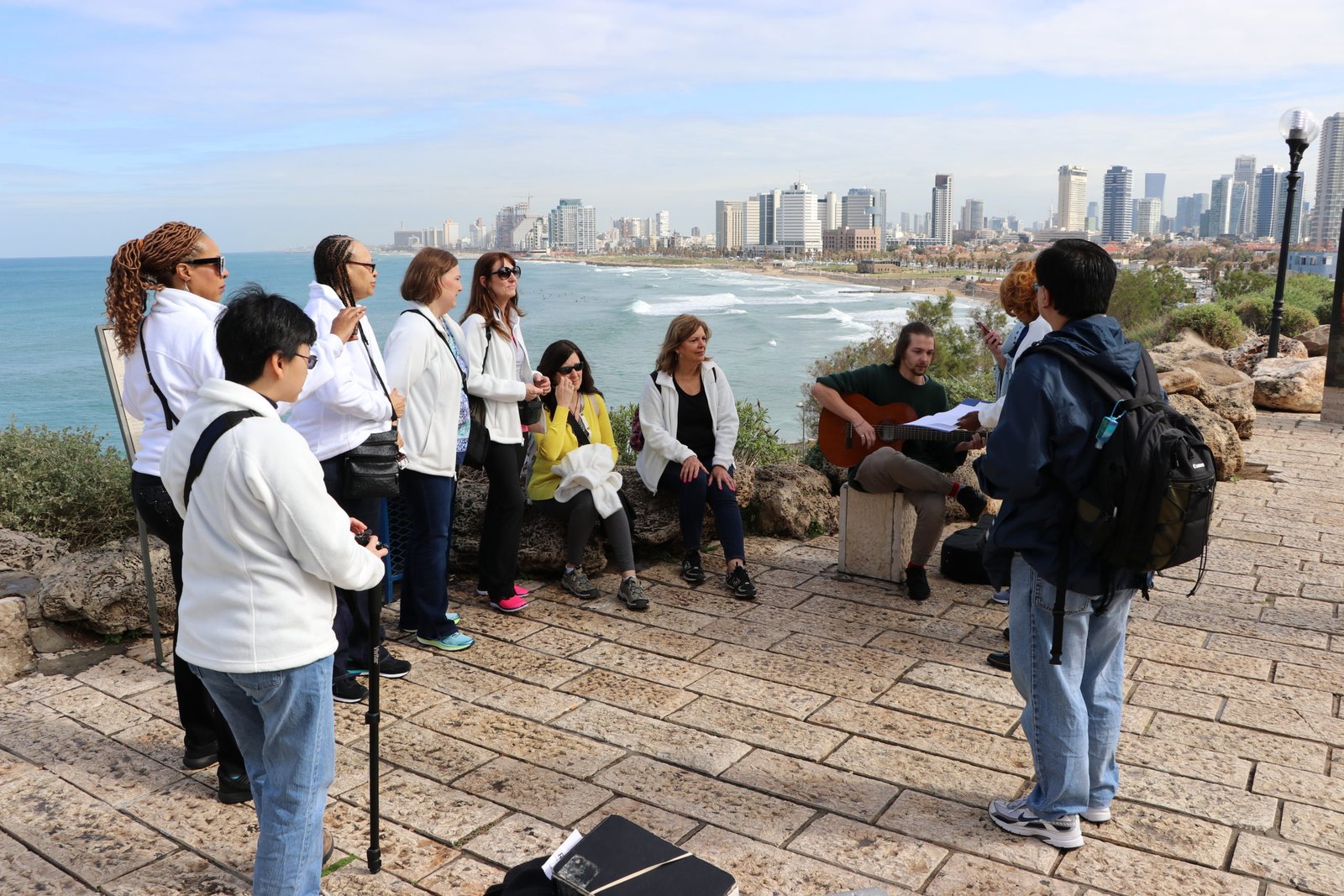
View Tel Aviv from Old Jaffa
Tel Aviv panorama
We are overlooking the busy, bustling, modern day metropolis of Tel Aviv from Old Jaffa. Locals call Tel Aviv the “Big Orange” named after the famous Jaffa oranges that still grow in area. In fact, you might have seen them from the airplane as you approached for landing. We can see ultra modern office buildings going up everywhere, in an assortment of interesting shapes and there are beautiful new garden condos lining the water front promenade.
Sand dune beginnings outside of Jaffa
Would you believe that in 1909, when Tel Aviv was founded outside the walls of old Jaffa, there was little more than sand dunes, sand flies, and malaria here. Today, Tel Aviv is a vibrant cosmopolitan city at the heart of the most dynamic economy in the Middle East. And this without one drop of crude oil below the surface, though there have been recent discoveries of natural gas. Tel Aviv also has the world’s largest exchange for polished diamonds and a world leader in high tech start-up companies. Tel Aviv is also the music and theater center of Israel. And all of this for a country just over 65 years old, that has faced an uphill battle for survival from the beginning.
How was Tel Aviv founded
Let’s examine how Tel Aviv got here- how it started. It’s a story that goes back a little over a hundred years ago- to the turn of the 20th century. There was an awakening of Jewish nationalism calling for a real practical return to Zion. We were always used to praying for the return to Zion, and still do. But this was different. This was a pro-active movement. A movement that said “just do it” and God will help and protect us along the way.
Back then, a handful of Jewish people arrived here by steamer from Europe, to the port of ancient biblical Jaffa. They came, not as tourists, but as pioneers; to fulfill a crazy dream – to rebuild the ancient biblical Jewish homeland. They were fired by a longing, an inner call for the Return to Zion.
The reality they met when they got off the boat was very different. Back in those days, before WWI, Palestine was just emerging from a deep slumber. It was a disease ridden backwater of the Ottoman Empire with malaria, glaucoma, no electricity, no running water, and an often hostile and a deeply corrupt local officials.
Nevertheless, overcoming hardship, these early Jewish settlers managed to purchase some land – sand dunes just outside the ancient walled city of Jaffa- the area in the foreground of the photograph, plan a new neighborhood, build their homes, and set down roots. The original neighborhood still exists, with gabled roof homes, narrow cobblestone streets, and even an old synagogue.
Ezekiel’s Valley of Dry Bones
What motivated them to come and invest their last pennies in an insecure place? No hard-nosed investment counselor would have suggested sinking time and money into such a troubled region!
The answer is linked to the origin and meaning of “Tel Aviv”. The name “Tel Aviv” comes from the prophet Ezekiel’s “Valley of Dry Bones” vision (Ezekiel 37:1-14) and is the place in his imagination that the vision unfolds. The story goes like this: In the year 586 B.C., the great Babylonian empire of Mesopotamia ( the area of Iraq today) was on the war path and conquered Jerusalem, laying waste the great Temple of Solomon. The Jews were taken into captivity and exiled to Babylon (southern Iraq today). There was a great sense of despair among the Jewish people. Even loss of faith. Existential questions were raised. How could our god Yahweh allow his House to be destroyed, his chosen people to be scattered? What about His promise to Abraham? Does God go back on his promises?
It was the prophet Ezekiel, the man of God, the man of faith who was exiled along with his people that rose to the occasion. He had a vision- the Valley of Dry Bones, reminding us that God’s promises are eternal. That there will come a time when the dry exiled bones of the nation of Israel would come to life again in His promised land.
Return to Zion
And so, when a handful of young Zionist families came from Europe as pioneers, fulfilling the biblical belief in the Return to Zion, bought some desolate sand dunes north of Jaffa to build their homes, they were like dreamers. They acted on vision. They sensed that they were active instruments of God in the building of a dream, the fulfillment of prophecy. In their minds they weren’t just building another neighborhood, but were laying the foundations for a new city. They dared dream that their little neighborhood would grow to become the infrastructure for the return and resurrection of the dry exiled bones of the Jewish people to their ancient home. Like the ripples that emanate from dropping a pebble into a pond, their tiny initiative – would grow into something greater than themselves.
Tel Aviv: “Hill of Spring”
And why is the name of the place that Ezekiel had his Vision of the Dry Bones called “Tel Aviv”? The name Tel Aviv is Hebrew, literally meaning “Hill of Spring”. Spring symbolizes rebirth and therefore encapsulates the whole message of the Vision of the Dry Bones- the promise of rebirth and new life that comes from the Lord.
Bauhaus White City
With the rise of Hitler many German Jewish architects fled and settled in Tel Aviv, bringing with them the Bauhaus or International Style of building. Today there are over 4000 buildings in this style in Tel Aviv, collectively known as the White City, and UNESCO has declared the ensemble a World Heritage Site.