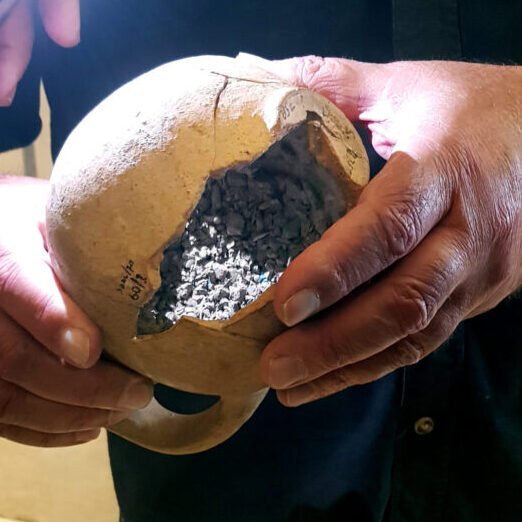
Biblical jug with raw silver from the time of King David
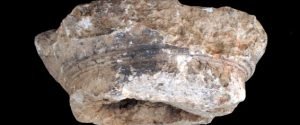
The jar you see in front of you was unearthed in the ancient biblical city of Eshtamoa (Israel) and according to some researchers dates back to the time of King David (10th century BC). The greyish material you see inside is raw silver which was commonly used before coins were invented. The Bible tells us that after David defeated the Amalekites he sent some of the plunder to the elders of Judah, saying “Here is a gift for you from the plunder of the Lord’s enemies” (1Samuel 30:26). Amongst them were the elders of Eshtamoa – the same city in which this jar was discovered. Since the location and age of the jar corresponds to that of the biblical story, it’s possible that this could be the plunder mentioned in the Bible. This simple jar therefore, might contain more than just raw silver, but a “hello” from King David 3000 years ago!
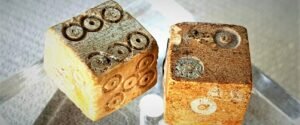
Archaeological excavations in Jerusalem don’t cease to bring the Bible alive! Here are a couple of 2000 year old stone dice from the 1st century AD when the Jewish Holy Temple, originally built by king Solomon, was still standing- before the Romans burned it down. These may be the very kind used by the Roman soldiers who cast dice to see who would get the clothes of Jesus after he was crucified. Biblical reference: “After they had crucified him, they [the Roman soldiers] determined who would get his clothes by throwing dice for them (Mt 27:35 King James)
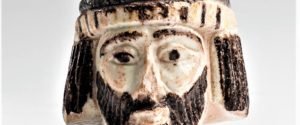
Statue head possibly of King Ahab (courtesy Israel Museum, Jerusalem)
Who hasn’t heard of Ahab (and his evil wife Jezebel), king of Israel at the time of #Elijah in the 9th century B.C.? Here is a first ever idea of what he may have looked like! Kinda cool I’d say! This exquisite faience head (courtesy of the Israel Museum) was found inside the royal citadel at Tel Abel Beth Maacah in upper Galilee, a biblical city, part of the northern kingdom of #Israel, and is actually dated to the 9th century BCE – the time of Ahab. And if it’s not king Ahab then it’s probably some other super important VIP such as King Hazael of Aram Damascus or King Ithobaal of Tyre, and gives a great idea about royal hairdos and styling at the time… Early 1970’s anyone?? Join me here in Israel and let me show you the real thing! Shalom, Zack Also see https://www.imj.org.il/en/exhibitions/royal-enigma
Happy Thanksgiving to all of our friends in America! But the message is universal and is echoed in the Bible itself…
Indeed, Thanksgiving is a holiday that surpasses borders and boundaries between countries and people and that all of us – here in Israel and around the world – can identify with. Here are few thanksgiving themes that are echoed in the three major biblical pilgrimage holidays to the Holy Temple in Jerusalem:
Thanksgiving for freedom
Pessach, also known as the Feast of Passover. We celebrate and give thanks to the Lord for His outstretched arm which released us from the shackles of bondage and brought us, as a family, to freedom in a land flowing with “milk and honey”.
Wheat fields Sorek Valley
Thanksgiving for God’s bounty
Shavuot, also known as the Feast of Pentecost or First Fruits. On this day, Jewish people from far and near would pour into Jerusalem bringing baskets of the very best of their harvest to the Great Temple in Jerusalem as a thanksgiving offering. Today we continue the tradition but our home is the holy Temple and our table is our altar.
Fresh baked Challah
Thanksgiving daily bread
Special bread is baked and placed upon our tables on all biblical holidays, including the Sabbath, as we give thanks to God, the eternal Provider. It is called “Challah”. We place a double portion on our tables, as a reminder of the double portion of Manna that God provided on Feast days, when no manner of work was permitted. Hallelujah – Praise the Lord!
Tabernacles Sukkah booth
Thanksgiving for shelter
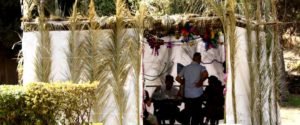
Sukkot, also known as the Feast of Tabernacles or Booths. On this day we give thanks to the Almighty for having a home, a shelter, and a roof over our heads. Each family builds a makeshift booth which we eat and even sleep in for a week, reminding as of how God sheltered our ancestors as they wandered in the Sinai wilderness and how He continues to shelter us today.
Psalms of Thanksgiving
There are so many expressions of Thanksgiving in the Bible; many to found in the book of Psalms itself. One of these is known as the “great Hallel” or Song of Praise, and was recited by Jesus himself at the closing of the Last Supper meal:
Psalm 136 (Selected Verses) 1 Give thanks to the LORD , for he is good. His love endures forever. 4 to him who alone does great wonders, His love endures forever. 5 who by his understanding made the heavens, His love endures forever. 6 who spread out the earth upon the waters, His love endures forever. 7 who made the great lights- His love endures forever. 10 to him who struck down the firstborn of Egypt His love endures forever. 11 and brought Israel out from among them His love endures forever. 12 with a mighty hand and outstretched arm; His love endures forever. 13 to him who divided the Red Sea [1] asunder His love endures forever. 14 and brought Israel through the midst of it, His love endures forever. 16 to him who led his people through the desert, His love endures forever. 23 to the One who remembered us in our low estate His love endures forever. 24 and freed us from our enemies, His love endures forever. 25 and who gives food to every creature. His love endures forever. 26 Give thanks to the God of heaven, His love endures forever.
Doric capital found from Solomon’s Portico in the Holy Temple of Jerusalem…
Discovered! Doric capital from Solomon’s Portico in the Holy Temple of Jerusalem (credit: Vladimir Naychin)
Whether celebrating Passover or Easter, the Paschal lamb sacrifice is a central theme. Here is a recent find from where it all happened 2000 years ago – the Holy Temple itself, that stood on Mount Moriah in Jerusalem! Discovered was a 28” diameter Doric capital from one of the monumental columns of Solomon’s Portico – a 1500 foot long covered colonnade porch that extended along the eastern side of the Temple Mount, and one of four such porticos that enclosed the Outer Court of the Temple. The beautifully preserved Doric capital, the first find of its kind, was sifted from rubble destructively dug up near the El Aksa mosque by the local Moslem religious authorities and dumped outside Jerusalem’s Old City walls.
Doric capital from the Parthenon temple in Athens (450 BC)
Strength, Simplicity, & Unity
The Doric capital is composed of a flared circle at the top (known as the “echinus) which transitions downward to three concentric circles (called “annulets”). It was topped by a square slab called the “abacus” upon which the colonnaded portico roof would sit. The characteristic unity and simplicity of the Doric style can be noticed in the 5th century BC Parthenon in Athens. Doric columns were fluted and tapered, and considered to be the stronger among the three Greek orders of columns (Doric, Ionic, Corinthian). For this reason, they would be used in the lower level of multistory structures such as the Roman Colosseum, an amphitheater built by the emperor Vespasian and his son Titus, who destroyed the Holy Temple in Jerusalem just a few years earlier.
Athens Doric portico
About Solomon’s Portico
We read about Solomon’s Portico, where the Doric capital came from, in the writings of Josephus Flavius, a kohen (Jewish priest, descendant of Aaron) who witnessed the destruction of the Temple by Titus the Roman in 70 CE: And now it was that the temple [in Jerusalem] was finished. So, when the people saw that the workmen were unemployed, who were above eighteen thousand, and that they, receiving no wages, were in want… they persuaded him [Agrippa, grandson of King Herod] to rebuild the eastern porticos… This was the work of king Solomon, who first of all built the entire temple. (Josephus, Antiquities 20,9,7)
Model of the Holy Temple in Jerusalem (destroyed by Titus in 70 AD) with colonnade porticos of outer court
Double row of columns – 42 feet high!
Josephus continues: The porticos [around the Outer Court of the Temple] were double [in width], and the pillars belonging to them were twenty-five cubits in height [~42 feet], and supported the portico. These pillars were of one entire stone each of them, and that stone was white marble; and the roofs [of the portico] were adorned with cedar, curiously graven. The natural magnificence, and excellent polish, and the harmony of the joints in these cloisters, afforded a prospect that was quite remarkable. (Josephus, Wars 5,5,2)
Jesus in Solomon’s Portico on Hanukkah Then came the Festival of Dedication [Hanukkah] at Jerusalem. It was winter and Jesus was in the temple courts walking in Solomon’s Portico. (Jn. 10:22-23)
Peter with lame beggar in Solomon’s Portico While the [healed lame] man held on to Peter and John,all the people were astonished and came running to them in the place called Solomon’s Portico. (Acts 3:11)
Apostles gather in Solomon’s Portico The apostles performed many signs and wonders among the people. And all the believers used to meet together in Solomon’s Portico. (Acts 5:12)
Come to Israel and discover more about Solomon’s Portico
I invite you to join me here in Israel. Tour with family, friends, or put together a group and save. We’ll experience a 3-D living color Bible. See the Doric capital from Solomon’s Portico and other authentic finds from the Holy Temple. We can even sift earth in search of artifacts and learn more about biblical Israel.
Discovered: Golden Bell from the High Priest robe in Jerusalem’s Holy Temple
Gold bell from hem of Jewish High Priest’s robe. (credit City of David & Israel Antiquities Authority)
Is it possible to hear an actual musical note from bible times? Well, here’s an incredible find that sheds light (photo credit City of David & Israel Antiquities Authority): The Bible and book of Psalms are full of references to musical sounds. We recall Miriam, the sister of Moses, who after the miraculous crossing of the Red Sea “took a timbrel in her hand… and sang” (Ex. 25:20) and David who would “take up his “kinor” (harp) and bring relief and solace to King Saul (1Sam.16:23). Ongoing archaeological excavations around Jerusalem in recent years have revealed so much to us from Bible times. In 2011, an actual golden bell, probably one of 72 that were sewn on the hem of the sky-blue “mei-eel” or robe, one of the eight vestments worn by the High Priest in the Holy Temple. We read about the golden bells in the book of Exodus:
Exodus 28:33-35
“And upon the hem of it thou shall make… a golden bell and a pomegranate, a golden bell and a pomegranate, upon the hem of the robe round about. It shall be on Aaron when he performs the service, and its sound shall be heard when he enters the Holy before the Lord and when he leaves, so that he will not die.” (Ex. 28:33-35)
Call to prayer and repentance
The Sages explain that the whole people gave themselves up to prayer and repentance, while the High Priest stepped into the Holy of Holies to officiate in their name. It was therefore most appropriate that they should all know the moment when he entered the Holy of Holies.
Discovery
The gold bell was discovered in an underground drainage channel dating from the time of Christ, when the Temple was still standing. The finely engraved, pomegranate shaped, gold bell was sealed all around, so it was x-rayed, and archaeologists could see the 4mm clapper, still intact. It was suspended on a gold wire, striking the bell precisely in the middle. The amazing thing is that the bell still rings! So it was sent to a music lab where it was sampled, amplified 72 times, and played back in rapid succession, the way the bells would have sounded on the hem of the vestments when the High Priest walked barefoot into the Holy of Holies of the Temple itself. Only the High Priest could enter the Holy of Holies, and then only on Yom Kippur – the Day of Atonement – the holiest day in the Jewish calendar, but his movements could, thanks to the bells, be heard..
Why the note “B”?
It’s interesting to note that the frequency of the bell is 240 hz, which corresponds closely to the musical note B. But why “B”? In the ancient world, the note B represented the planet Saturn or Saturday, which was the 7th day of the week. For the Jews of course this is the Sabbath day, known as “Shabbat” in Hebrew. Indeed the word for bell in Hebrew, “pa’amon” has a numeric value of 240. So the ringing of the bells on the hem of the High Priest sounded out a central tenant and message of our biblical faith: The Sabbath, the celebration of life, and belief in a premeditated act of Creation by a Creator.
Visit Israel & see the golden bell remains of the Holy Temple in Jerusalem I invite you to join me here in Israel and experience a 3-D living color Bible- a blessing without measure! Shalom! Shalom! Zack Shavin, Jerusalem
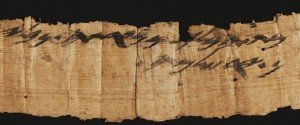
This ancient 7th century BC papyrus is the first mention of Jerusalem in Hebrew outside the Bible (photo Israel Antiquities Authority)
Papyrus mention of Jerusalem (Israel Antiquities Authority)
Jerusalem is indeed famous, mentioned over 800 times in the Bible. But do we have any ancient historical documents that connect the Jews with Jerusalem OUTSIDE of the Bible? The answer is YES! The Israel Antiquities Authority has recently recovered a 2700 year old, 7th century B.C. papyrus fragment written in ancient Hebrew script, language of the Jewish people and Old Testament, and contains the earliest Hebrew mention of Jerusalem outside the Bible.
Royal Wine shipment
The papyrus is part of a royal bill of lading (official shipping document) of jars of wine sent from Na’aratah (vic. Jericho – see Josh. 16:7) to JERUSALEM, capital of the kingdom of Judea.The papyrus fragment, miraculously preserved by the dry Judean desert around the Dead Sea, was sent to the world famous Weizmann Institute for testing and was dated to the 7th century B.C.- over 2600 years old! The period of the papyrus document is that of the Temple of Solomon, the kings of Judaea (probably Josiah, who instituted a religious reform), and the prophet Jeremiah. It predates the 586 BC Babylonian conquest of Judea and subsequent exile of the Jewish people to Babylon.For comparison sake, the papyrus document predates the Dead Sea Scrolls (2nd century BC), by over 500 years!
Jerusalem papyrus (Israel Antiquities Authority)
Hebrew text
Note the last word on left in the 2nd line (yellow): “Yerushalima” (to Jerusalem):
מא]מת. המלך. מנערתה. נבלים. יין. ירשלמה]
Transliteration: [me-a]mat. ha-melekh. me-Na’artah. nevelim. ya’yin. Yerushalima.
Translation: [From the] king’s maidservant, from Na?arat, jars of wine, to Jerusalem
Come to Israel and let me show you this 2,700 year old papyrus from the 7th century BC – the first mention of Jerusalem in Hebrew outside the Bible – as well as the famed Dead Sea Scrolls and other biblical sites. Shalom!!! Zack Shavin
The 2000 year old Arch of Titus celebrates Roman victory over Judea, depicting soldiers carrying Jerusalem Temple treasures into Rome.
With the recent UNESCO (United Nations Educational, Scientific, and Cultural Organization!!!) vote denying any Jewish connection to the Western Wall and Temple Mount (Mount Moriah) where the Mosque of Omar and El Aksa Mosques stand today, I’d like to suggest that the supporters of the resolution visit the Arch of Titus situated close by the Coliseum next time they are in Rome. The 2000 year old arch was built to honor Titus who laid siege to Jerusalem in the year 70 A.D. and destroyed the Jewish Holy Temple that stood on Mount Moriah.
Arch of Titus: Roman soldiers carrying the golden Menorah into Rome
Depicted on the arch are Roman soldiers carrying the Menorah (seven branched golden candelabrum) into Rome, as well as other Temple treasures such as the Golden Trumpets and Show Bread offering table which was made of acacia wood and covered with gold. The Jewish revolt against Roman tyranny and the attempt to reestablish independence broke out in Caesarea (Mediterranean coast) in 66 A.D. and ended seven years later with the fall of Masada in 73 A.D. The Western Wall is a remnant of the massive support walls that encircled and supported the Temple Mount platform and upon which the Moslems later built the Dome of the Rock mosque, also known as the Mosque of Omar.
Rosh Hashana, the biblical Jewish New Year is described in the Torah (Lev. 23:24) as a “zikhron teruah”: A time of “blowing [of the shofar] of remembrance”.
WHAT are we to “remember” and WHY do we blow the Shofar (ram’s horn)? Rosh Hashana not only marks the biblical New Year and therefore new beginnings, but is also the anniversary of the Creation, culminating in the creation of humankind – Adam & Eve- on the sixth day. On Rosh Hashana we crown and proclaim God as king of the universe and remind ourselves that the Creation was an act of the purest love, that we are all created equal as beloved children of God, and that we are called to emulate God by going go out into the world and doing acts of loving kindness in our everyday lives – both at home and at work.
Why do we blow the shofar?
The “shofar (ram’s horn) of remembrance” (Lev. 23:24) reminds us of God’s servant Abraham, the depth of his faith with the sacrifice of Issac, and how he took the ram instead when the angel stopped his hand. Abraham was chosen by God not only because of his faith, but more importantly because of his quality of “chesed”- loving kindness towards all human beings, including strangers- and willingness to act on their behalf. This is demonstrated in the story of Sodom and Gemorrah and how he pleads with God not to destroy the evil pagan inhabitants.
In closing, may this Rosh Hashana, Day of Remembrance and Jewish New Year, be one of true remembrance of the blowing of the Shofar ram’s horn and even greater resolve to emulate Abraham in spreading peace and loving kindness in our homes, communities, and the world.
What kind of father was Joseph and what kind of home did Jesus grow up in?
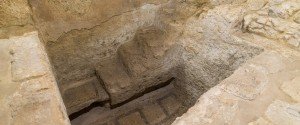
Mikve, St. Joseph church
To answer this let’s have a closer look at what Joseph did for a living in Nazareth: In Matthew 13:55 we read in reference to Jesus: “Is this not the carpenter’s son?” In Greek the word used (and translated as “carpenter”) is actually “tectonus”, which means “builder”. In other words, Joseph had a building business of sorts, working not only in wood but also in stone. Indeed, building in the Holy Land has always been largely out of stone since wood is scarce (Solomon ordered Cedars from Hiram in Lebanon) and to this day old Nazareth is built out stone. Now, all you guys know that construction is a tough business that can go either way financially, belly up or success if you’re good at what you do.
Mary’s private mikve ritual bath Now here’s some ARCHAEOLOGICAL evidence that suggests that Joseph (who we know so little about from the Bible) was indeed quite a successful builder: That he made a good living, and provided a really nice home for his family. Above is a photo of a bonafide “mikve” (Jewish ritual bath) taken by a friend of mine, Dr. Tom Winger (whose pastors tour I guided). It was discovered beneath the Church of St. Joseph in Nazareth which is built over the traditional home of Joseph and Mary, where Jesus grew up.
To be kosher, the MIKVE ritual bath has to be cut out of solid rock (not constructed), hold a minimum of 40 seah (~40 gallons), and be fed by “living water” (non-drawn water) – usually rain water from the roof. Here’s the thing: Such elaborate Jewish ritual baths are quite expensive and are therefore generally built by a Jewish community at the local synagogue. Only the wealthy could afford to install a private one in their home. This is evidenced by a 2000 year old mikve ritual bath we found in a 7,000 square foot Herodian style mansion in Jerusalem from the time of the Temple.
Biblical home and family life
So what kind of father was Joseph and what kind of home did Jesus grow up in? Joseph appears to have been quite a guy: The biblical role model of a father and “family man” who worked hard, made a good living, and provided a beautiful home for his wife Mary, who wouldn’t have had to “shlep” to the local synagogue on a cold rainy winter night to use the public mikve ritual bath. This and more… as a successful builder Joseph also had the means, coupled with the right priorities, to provide Jesus with a top notch biblical education: Jesus is called “Rabbi” in the Bible, which means he probably studied in a yeshiva (rabbinical school) but that’s another story.