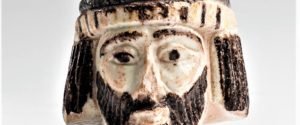
Statue head possibly of King Ahab (courtesy Israel Museum, Jerusalem)
Who hasn’t heard of Ahab (and his evil wife Jezebel), king of Israel at the time of #Elijah in the 9th century B.C.? Here is a first ever idea of what he may have looked like! Kinda cool I’d say! This exquisite faience head (courtesy of the Israel Museum) was found inside the royal citadel at Tel Abel Beth Maacah in upper Galilee, a biblical city, part of the northern kingdom of #Israel, and is actually dated to the 9th century BCE – the time of Ahab. And if it’s not king Ahab then it’s probably some other super important VIP such as King Hazael of Aram Damascus or King Ithobaal of Tyre, and gives a great idea about royal hairdos and styling at the time… Early 1970’s anyone?? Join me here in Israel and let me show you the real thing! Shalom, Zack Also see https://www.imj.org.il/en/exhibitions/royal-enigma
What kind of father was Joseph and what kind of home did Jesus grow up in?
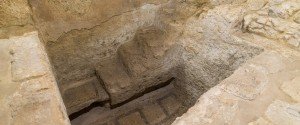
Mikve, St. Joseph church
To answer this let’s have a closer look at what Joseph did for a living in Nazareth: In Matthew 13:55 we read in reference to Jesus: “Is this not the carpenter’s son?” In Greek the word used (and translated as “carpenter”) is actually “tectonus”, which means “builder”. In other words, Joseph had a building business of sorts, working not only in wood but also in stone. Indeed, building in the Holy Land has always been largely out of stone since wood is scarce (Solomon ordered Cedars from Hiram in Lebanon) and to this day old Nazareth is built out stone. Now, all you guys know that construction is a tough business that can go either way financially, belly up or success if you’re good at what you do.
Mary’s private mikve ritual bath Now here’s some ARCHAEOLOGICAL evidence that suggests that Joseph (who we know so little about from the Bible) was indeed quite a successful builder: That he made a good living, and provided a really nice home for his family. Above is a photo of a bonafide “mikve” (Jewish ritual bath) taken by a friend of mine, Dr. Tom Winger (whose pastors tour I guided). It was discovered beneath the Church of St. Joseph in Nazareth which is built over the traditional home of Joseph and Mary, where Jesus grew up.
To be kosher, the MIKVE ritual bath has to be cut out of solid rock (not constructed), hold a minimum of 40 seah (~40 gallons), and be fed by “living water” (non-drawn water) – usually rain water from the roof. Here’s the thing: Such elaborate Jewish ritual baths are quite expensive and are therefore generally built by a Jewish community at the local synagogue. Only the wealthy could afford to install a private one in their home. This is evidenced by a 2000 year old mikve ritual bath we found in a 7,000 square foot Herodian style mansion in Jerusalem from the time of the Temple.
Biblical home and family life
So what kind of father was Joseph and what kind of home did Jesus grow up in? Joseph appears to have been quite a guy: The biblical role model of a father and “family man” who worked hard, made a good living, and provided a beautiful home for his wife Mary, who wouldn’t have had to “shlep” to the local synagogue on a cold rainy winter night to use the public mikve ritual bath. This and more… as a successful builder Joseph also had the means, coupled with the right priorities, to provide Jesus with a top notch biblical education: Jesus is called “Rabbi” in the Bible, which means he probably studied in a yeshiva (rabbinical school) but that’s another story.
Why “stone” water jars at the wedding in Cana of Galilee?
Travelling from Nazareth to the Sea of Galilee we pass through Cana in Galilee where according to the New Testament Scriptures Jesus changed six “stone” jars of water to wine at the wedding. What did they actually LOOK like and WHY does the Bible stipulate they were made out of “stone” rather than the usual clay pottery?
Stone water jars
Mention in John 2:1-6
Dear friends, Many of heard about biblical stone water jars, but how many of actually SEEN one? We read about them in the New Testament in connection to a Jewish wedding in Cana where Jesus changes water to wine: “On the third day a wedding took place at Cana in Galilee… Nearby stood six stone water jars, the kind used by the Jews for ceremonial washing, each holding from twenty to thirty gallons.” (John 2:1-6).
Biblical stone water jar discovered
Well, here’s the real McCoy, discovered in an excavation, some 15 feet below the Jewish Quarter in the Old City of Jerusalem. The stone water jar was carved and polished by hand out of one chunk of limestone and stood inside a 7500 sq. foot palatial home and probably belonged to a wealthy Cohen (priestly) Jewish family who lived in Jerusalem at the time of Jesus – when the Temple was still standing.
Why made out of stone? In Lev. 11:36 we read: “Only a spring and a [stone] pit… shall be clean”. In other words, only a stone water container is “clean” and doesn’t become ritually impure if it comes in contact with death (for example if a mouse is found dead in it):
Problem of ritual impurity
If on the other hand the water container was made of ceramic (rather than stone) it could be rendered ritually impure, as would the water itself AND the priest that used it! This was no small matter, for in such a state of ritual impurity a priest (such as Zachariah, father of John the Baptist) couldn’t serve in the Jerusalem Temple or eat of the holy sacrifices and offerings that pilgrims brought!
Wedding hall where all could partake & celebrate
So getting back to the story of the “six stone water jars” mentioned in John 2, if you were a wedding hall owner in Galilee 2000 years ago and wanted your clients to be able to invite their priest friends to the reception, you’d invest in a set of expensive stone vessels (rather than cheaper ceramic). Of course it would cost more, but hey, one doesn’t get married everyday (hopefully) and you’d want your wedding reception clients to be able to invite all of their friends.
Stand at Armageddon (Revelations 16:16) overlooking the Valley of Jezreel (Hosea 1:4), and place of Ezekiel’s End of Days war of Gog and Magog. Here is the crossroads of the world where three intercontinental highways converge- from Europe, Asia, and Africa.
Valley of Armageddon
Valley of Armageddon
We are standing atop the biblical mound of Megiddo, one of the most important cities in Bible times, looking out over the Jezreel Valley, also known as Armageddon in the New Testament. The name Armageddon is a Hebrew word that literally means “Hill of Megiddo”. We read about it in Revelations – the last book of the New Testament with regard to the End of Days war: “And I gathered them [the nations] unto a place known in the Hebrew tongue as Armageddon” (Rev. 16:16)
War of God & Magog
This End of Days battle is also alluded to in the Gog and Magog war described in Ezekiel (38:3-23): “Thus said the Lord: Behold, I am against you, Gog, the prince… I will summon a sword against Gog on all my mountains… I will execute judgment on him with plague and bloodshed; I will pour down torrents of rain, hailstones and burning sulfur on him and on his troops and on the many nations with him. And so I will show my greatness and my holiness, and I will make myself known in the sight of many nations. Then they will know that I am the Lord.’.
Book of Revelations
In Revelations 20:7 we read more on the End of Days battle: “When the thousand years are finished, Satan shall be loosed out of his prison, and shall come forth to deceive the nations which are in the four corners of the earth, Gog and Magog, to gather them together to the war.”
Crossroads of the world
So why did this place – Armageddon – take on an association with an End of Days war? The answer lies in the geography of the area. Three intercontinental roads converge here in the valley, from Europe, Asia, and Africa. And for that reason all the great conquerors of antiquity have passed this way: Alexander the Great from the north (Greece), Nebuchadnezzer from the east (Babylon), and the pharaoh Thutmoses III from the south (Egypt). Another interesting point- it’s pretty much equal distance from this spot to the some of the world’s most strategic capital cities: Madrid, Paris, Moscow, Bombay, and Nairobi!!!
Why is it also called Jezreel?
The name Jezreel – Yizra’el in Hebrew- means “God will sow”. As the largest and most fertile valley of the country, it was in bible times the bread basket of the country. The significance of the name, and nature of the area as prime farm land, raises the biblical question, “who” will sow the seed and provide grain, the staff of life: The God of love and justice that that lives within us, or the pagan stone gods? Indeed, on nearby Mount Carmel, Elijah called the people to decide who is the true provider- Yahweh or Ba’al (Canaanite equivalent of Zeus or Jupiter). In the Bible God warns the people that if they follow the pagan gods he will bring drought upon the land, there will be no rain, and then of course no wheat, as it is a rain dependent crop, not an irrigated one.
Jezreel son of Gomer the harlot
Jezreel is also the name of the prophet Hosea’s son from the harlot Gomer whom he married (Hosea 1:3-4). God asked Hosea (8th century BC) to marry a harlot in order to demonstrate what real devotion and love is. Such was the love and devotion of Yahweh to his people, in spite of their behavior as harlots, chasing the skirts of the pagan gods.
The beautiful and pastoral Sea of Galilee with its majestic dates & palm groves, and fed by the Jordan River, is a favorite among Holy Land pilgrims. Jesus settled here in the Jewish fishing town of Capernaum after leaving Nazareth.
Sea of Galilee
Soulful sea…
Ahh, yes, the Sea of Galilee… You may have sailed the “Seven Seas”, but if you haven’t sailed on the Sea of Galilee… What can I say- this one’s got SOUL brother! No wonder so many miracles happened in this spot and that it’s a favorite, not only among millions of pilgrims, but with locals too- finding in this place where G-d speaks, peace, tranquility, and inspiration.
Kinneret or Sea of the Harp
Actually, in Hebrew, the language of Scripture, the lake is called the “Sea of Kinneret”, which means “Sea of the Harp”. Look at the map on the blog site and you’ll see that it indeed has the shape of a harp, which is a reminder of the Harp of David. Indeed, according to biblical tradition the Messiah will come out of the House of David. No wonder, in the New Testament, Jesus leaves his hometown of Nazareth and comes down to the Sea of Galilee, where he spends the last three years of his life: He settles in the ancient lakeside Jewish town of Capernaum where he centers his public ministry as a roaming rabbi – teacher – miracle-worker.
Jordan River
The Sea of Galilee is a actually a freshwater lake, fed by the Jordan River on the northern end. The lake is bigger than most people imagine: 25 km X 15 km (~15 X 7 miles) and 50 meters (~150 feet) deep. It’s part of the Great Rift Valley extending from Turkey to East Africa and is about 200 meters (over 600 feet) below sea level. No wonder it’s so warm, lush, and brimming with tropical and subtropical vegetation: Bananas, Mango, Avocado, Bougainvillea.
Dates & Date Palms
At the southern end of the Sea of Galilee, where the Jordan River flows out of the lake and winds its way south to the Dead Sea, are beautiful date palm groves, famous since Bible times. The dates were brought to the Holy Temple in Jerusalem as a First Fruits offering and are today exported all over the world.
Sail on the Sea of Galilee
I invite you to join me in discovering the delight of the Sea of Galilee. Together we’ll set set sail aboard one of the wooden boats pictured on this page, cut the motor, and just listen to the silence, the wind, and gentle lapping of the water. Reflecting on the meaning of this very special place, that has little changed since Bible times, you may find yourself breaking out your Bible, singing a hymn, and even kicking up your heels in joy!