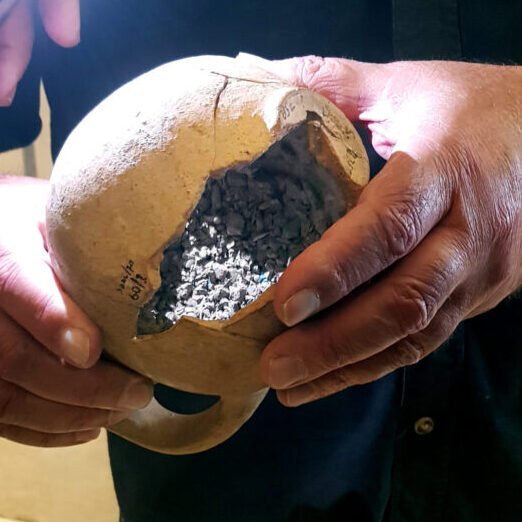
Biblical jug with raw silver from the time of King David
The jar you see in front of you was unearthed in the ancient biblical city of Eshtamoa (Israel) and according to some researchers dates back to the time of King David (10th century BC). The greyish material you see inside is raw silver which was commonly used before coins were invented. The Bible tells us that after David defeated the Amalekites he sent some of the plunder to the elders of Judah, saying “Here is a gift for you from the plunder of the Lord’s enemies” (1Samuel 30:26). Amongst them were the elders of Eshtamoa – the same city in which this jar was discovered. Since the location and age of the jar corresponds to that of the biblical story, it’s possible that this could be the plunder mentioned in the Bible. This simple jar therefore, might contain more than just raw silver, but a “hello” from King David 3000 years ago!
Leaving Jerusalem, we follow the main road to Emmaus, a biblical Jewish town that became known as Nicopolis in the late Roman Byzantine period. Here passed Joshua, the Maccabees, Crusades, & Jesus who, according to the New Testament Book of Luke, appeared after Calvary and the Resurrection.
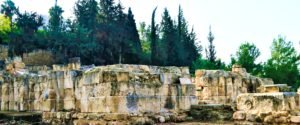
Emmaus: Byzantine & Crusader church
A real biblical place…
The rich history of Emmaus is marked by the passage of many conquerors and famous people. The Book of Joshua tells how the sun and moon stood still over the adjacent Ayalon Valley when Joshua marched with the Israelites on Gibeon- north of Jerusalem – some 3200 years ago. In 165 BC, Judah Maccabee, one of the important heroes of Hanukkah, won an important victory nearby against the Greek troops of Nicanor. This opened the way to Jerusalem and made it possible for the Jews to purify the Temple which had been desecrated by the Greeks and re-establish the Divine Service, a victory celebrated by the feast of Hannukah every year.
The place where Jesus broke bread
By the time of Jesus’ public ministry (~30 AD) Emmaus had become a simple village. It was here, after the Resurrection, that Jesus appears to his disciples, who recognized Him in the breaking of bread (Lk. 24:13-35).
Byzantine period: Christian pilgrimage
In the 3rd century AD there was a Christian community in Emmaus and the town was given a new name, Nicopolis or City of Nike – Greek goddess of victory. During the Byzantine period (4-7 centuries) Emmaus Nicopolis became an important Christian administrative center and a basilica to serve Christian pilgrims was built at the traditional site of Jesus’ apparition.
Crusades
Byzantine churches which had earlier been destroyed were built by the Crusaders in the 12th century, and subsequently destroyed after the Arab reconquest of the Holy Land. Impressive remains are still visible.
Modern times
It was only in 1878, at the initiative of Miriam of Bethlehem, that the Carmelite convent of Bethlehem acquired the site. Since then, it has once again become a place of pilgrimage.
Excavations
Excavations in 1880, 1924, and recent years unearthed the remains of two imposing Byzantine basilicas with beautiful mosaics, a baptistery, and the ruins of a Crusader church.
Gospel according to Luke 24,13-35
“That very day two of them were going to a village named Emmaus, about a hundred and sixty stadia from Jerusalem, and talking with each other about all these things that had happened. While they were talking and discussing together, Jesus himself drew near and went with them. But their eyes were kept from recognizing him… So he went in to stay with them. When he was at table with them, he took the bread and blessed, and broke it, and gave it to them. And their eyes were opened and they recognized him; and he vanished out of their sight…”
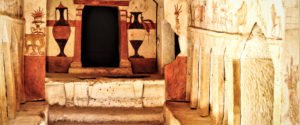
The Sidonian Tomb discovered at the biblical city of Beit Guvrin – Maresha in the foothills of Judea southwest of Jerusalem, is an extraordinary rock-carved and hand-painted burial complex. It belonged to Phoenician traders from Sidon that settled in southern Judea after Alexander the Great’s conquests (332 BC).
Sidonian tomb
Explore a biblical city…
There aren’t remains of too many ancient cities that one can wander through and see how people lived over 2000 years ago! Well, Beit Guvrin / Maresha, situated in the foot hills of Judea is one of them. Today we explore the colorful mausoleum of a wealthy family of traders that came from Sidon (Lebanon today) and settled here in the 2-3rd century BC.
Why situated here?
Situated at the foot of the Judean Hills, between the Mediterranean coast and the mountains, Maresha was on an important trade route connecting Hebron and the port city of Ashkelon.
Greek speaking settlers from Sidon
Sidon was and still is an important seaport- just north of Israel, on the Lebanon coast. In bible times it was home to Phonecian traders that plied the Mediterranean establishing trading posts as far away as Spain and the Atlantic Ocean. They also settled here. From the time of Alexander the Great (3rd C. BCE) it became Greek speaking and as pagans they worshipped the Greek gods.
Burial caves with colorful paintings
The soft local chalk allowed the locals at Maresha to carve out extensive subterranean tombs and even underground workshops. The colorful wall paintings depict, plants and animals from everyday life such as a lion, snake, fox while some of them are mythological. Musicians accompany the funeral train. They are short, pudgy, and appear to be somewhat jovial types. One of the instruments is a double reed flute that can still be found in the region. A loving and kind person
Apollophanes: Leader of the local Sidonian community
In the tomb depicted here archaeologists found an inscription mentioning the wealthy head of the local Sidonian community buried here. His name was Apolophanes son of Sesmaios, leader of the Sidonian community in Maresha. On a human note, the inscription goes on to say that Apolphanes was a kind, loving, generous, and well liked person. And here we are remembering him over 2000 years later! A name and memory worth more than a person’s weight in gold – can anyone wish for more?