Category: Traditions

  • Biblical Thanksgiving

    Biblical Thanksgiving

    Happy Thanksgiving to all of our friends in America!  But the message is universal and is echoed in the Bible itself…

    Indeed, Thanksgiving is a holiday that surpasses borders and boundaries between countries and people and that all of us – here in Israel and around the world – can identify with. Here are few thanksgiving themes that are echoed in the three major biblical pilgrimage holidays to the Holy Temple in Jerusalem:

    Thanksgiving for freedom 
    Pessach, also known as the Feast of Passover.  We celebrate and give thanks to the Lord for His outstretched arm which released us from the shackles of bondage and brought us, as a family, to freedom in a land flowing with “milk and honey”.

    Wheat fields Sorek Valley
    Wheat fields Sorek Valley

    Thanksgiving for God’s bounty
    Shavuot, also known as the Feast of Pentecost or First Fruits.  On this day, Jewish people from far and near would pour into Jerusalem bringing baskets of the very best of their harvest to the Great Temple in Jerusalem as a thanksgiving offering.  Today we continue the tradition but our home is the holy Temple and our table is our altar.

    Fresh baked Challah bread
    Fresh baked Challah

    Thanksgiving daily bread
    Special bread is baked and placed upon our tables on all biblical  holidays, including the Sabbath, as we give thanks to God, the eternal Provider.  It is called “Challah”.  We place a double portion on our tables, as a reminder of the double portion of Manna that God provided on Feast days, when no manner of work was permitted. Hallelujah – Praise the Lord!

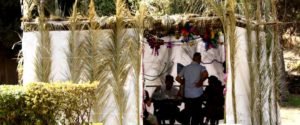
    Tabernacles Sukkah booth
    Tabernacles Sukkah booth

    Thanksgiving for shelter 
    Sukkot, also known as the Feast of Tabernacles or Booths.  On this day we give thanks to the Almighty for having a home, a shelter, and a roof over our heads.  Each family builds a makeshift booth which we eat and even sleep in for a week, reminding as of how God sheltered our ancestors as they wandered in the Sinai wilderness and how He continues to shelter us today.

    Psalms of Thanksgiving
    There are so many expressions of Thanksgiving in the Bible; many to found in the book of Psalms itself.  One of these is known as the “great Hallel” or Song of Praise, and was recited by Jesus himself at the closing of the Last Supper meal:

     Psalm 136 (Selected Verses)
    1 Give thanks to the LORD , for he is good. His love endures forever.
    4 to him who alone does great wonders, His love endures forever.
    5 who by his understanding made the heavens, His love endures forever.
    6 who spread out the earth upon the waters, His love endures forever.
    7 who made the great lights- His love endures forever.
    10 to him who struck down the firstborn of Egypt His love endures forever.
    11 and brought Israel out from among them His love endures forever.
    12 with a mighty hand and outstretched arm; His love endures forever.
    13 to him who divided the Red Sea [1] asunder His love endures forever.
    14 and brought Israel through the midst of it, His love endures forever.
    16 to him who led his people through the desert,  His love endures forever.
    23 to the One who remembered us in our low estate His love endures forever.
    24 and freed us from our enemies, His love endures forever.
    25 and who gives food to every creature. His love endures forever.
    26 Give thanks to the God of heaven, His love endures forever.

  • No Jewish link to Jerusalem Temple Mount???

    No Jewish link to Jerusalem Temple Mount???

    The 2000 year old Arch of Titus celebrates Roman victory over Judea, depicting soldiers carrying Jerusalem Temple treasures into Rome.

    With the recent UNESCO (United Nations Educational, Scientific, and Cultural Organization!!!) vote denying any Jewish connection to the Western Wall and Temple Mount (Mount Moriah) where the Mosque of Omar and El Aksa Mosques stand today, I’d like to suggest that the supporters of the resolution visit the Arch of Titus situated close by the Coliseum next time they are in Rome.   The 2000 year old arch was built to honor Titus who laid siege to Jerusalem in the year 70 A.D. and destroyed the Jewish Holy Temple that stood on Mount Moriah.

    Arch of Titus: Jewish prisoners carrying the golden Menorah into Rome
    Arch of Titus: Roman soldiers carrying the golden Menorah into Rome

    Depicted on the arch are Roman soldiers carrying the Menorah (seven branched golden candelabrum) into Rome, as well as other Temple treasures such as the Golden Trumpets and Show Bread offering table which was made of acacia wood and covered with gold.  The Jewish revolt against Roman tyranny and the attempt to reestablish independence broke out in Caesarea (Mediterranean coast) in 66 A.D. and ended seven years later with the fall of Masada in 73 A.D. The Western Wall is a remnant of the massive support walls that encircled and supported the Temple Mount platform and upon which the Moslems later built the Dome of the Rock mosque, also known as the Mosque of Omar.

  • Rosh Hashana: Why Blow the Shofar?

    Rosh Hashana: Why Blow the Shofar?

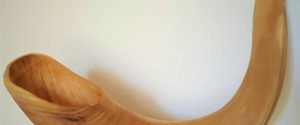
    Rosh Hashana, the biblical Jewish New Year is described in the Torah (Lev. 23:24) as a “zikhron teruah”: A time of “blowing [of the shofar] of remembrance”.

    WHAT are we to “remember” and WHY do we blow the Shofar (ram’s horn)?  Rosh Hashana not only marks the biblical New Year and therefore new beginnings, but is also the anniversary of the Creation, culminating in the creation of humankind – Adam & Eve- on the sixth day.  On Rosh Hashana we crown and proclaim God as king of the universe and remind ourselves that the Creation was an act of the purest love, that we are all created equal as beloved children of God, and that we are called to emulate God by going go out into the world and doing acts of loving kindness in our everyday lives – both at home and at work.

    Why do we blow the shofar? 
    The “shofar (ram’s horn) of remembrance” (Lev. 23:24) reminds us of God’s servant Abraham, the depth of his faith with the sacrifice of Issac, and how he took the ram instead when the angel stopped his hand. Abraham was chosen by God not only because of his faith, but more importantly because of his quality of “chesed”- loving kindness towards all human beings, including strangers- and willingness to act on their behalf.  This is demonstrated in the story of Sodom and Gemorrah and how he pleads with God not to destroy the evil pagan inhabitants.

    In closing, may this Rosh Hashana, Day of Remembrance and Jewish New Year, be one of true remembrance of the blowing of the Shofar ram’s horn and even greater resolve to emulate Abraham in spreading peace and loving kindness in our homes, communities, and the world.

  • Golden Menorah

    Golden Menorah

    Menorah: Golden Lampstand

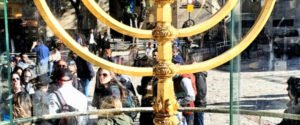
    The seven branch Menorah or Golden Lampstand, a reminder of the seven days of Creation, was cast from one talent of gold and stood in the Tabernacle of Moses and later in Solomon’s Temple in Jerusalem.

    Golden Menorah
    Golden Menorah

    Divinely inspired
    Did you know that the Menorah or Golden Lampstand, as it is translated in many Bibles, was specially designed by God? It’s a “divine design” by the Master Creator of the universe and, following God’s instructions detailed in the Bible (Exodus 25:31-40). It had seven branches and was cast in one piece using 1 talent of pure gold: “Make a lampstand of pure gold. Hammer out its base and shaft, and make its flowerlike cups, buds and blossoms of one piece with them… A talent of pure gold is to be used for the lampstand and all these accessories.”

    Where was the Menorah placed?
    God proscribed that it should be placed in the Tabernacle – the portable temple – that the Israelites carried through the wilderness for 40 years, on the way from Egypt to the Promised Land. Later on it was places in the Holy Temple that king Solomon built on Mount Moriah in Jerusalem (“Solomon’s Temple”). Throughout history the Jewish people have incorporated it into synagogue design and today it is the symbol of the modern state of Israel- it’s that important! Let’s look at the meaning of the word Menorah. In most bibles it is translated as Golden Candlestick or Candelabrum. What is so special about it? Why is it holy and what does it represent?

    How much is one talent of gold?
    One talent (kikar in Hebrew) is worth 3000 shekels. There are various evaluations of how much a shekel weighs, but if we take an average of 12 grams/ shekel X 3000 = 3.6 kilos. At a gold value of  $1,108 per troy ounce = approximately $128,000!

    Why the number seven?
    The seven branches or lights are not by coincidence. In the Bible, the number seven reminds us of the seven days of creation in the biblical book of Genesis. Seven in Hebrew- sheva – means fullness- to be totally filled and fulfilled. It was indeed what God felt when he finished his masterwork of Creation and His jewel-in-the- crown: Us! And then he “rested” on the seventh day- i.e. kicked back and said “Wow!”. He had humanity to lavish his love upon, with the hope, since we were created in His image, that we’d turn around and to the same with each other in fulfilling the commandment “love your neighbor as yourself”.

    What is the significance of the lights?
    The name “menorah” comes from the Hebrew root meaning “light” . So the emphasis is not on the actual candle holder but on the subject of “light” within the biblical creation story of the seven days. Indeed, the first thing God did – on the 1st day was to create light- “Let there be light!”. What kind of light was it? Not necessarily a physical light, but more importantly the Divine Light – which increased day by day throughout the Creation story as God planted himself in every nook and cranny of Creation- until it was All Pervading- as represented by the Menorah. But God’s menorah is not candles or oil lamps- it is people. Indeed in the book of Proverbs it says, “The spark, the lamp, of God (i.e. the divine light) is the soul of man.”. In other words, we, each human being, is a divine light, carrying the divine spark that was created on the 1st day. Through our actions we can choose to increase the divine light within ourselves or diminish it. The choice is ours, in the way we conduct our daily lives.

    What happened to the original Menorah?
    When Titus burned down the Holy Temple in Jerusalem he looted it and removed the Golden Lampstand. It was then paraded through the streets of Rome along with Jewish prisoners of war as depicted on the Arch of Titus near the Colosseum in Rome. His father Vespasian deposited the Menorah together with the other booty in the special temple which he erected after the Jewish Revolt against Rome in the years 66-73 AD. (Josephus Flavius: Wars 1:148-50) The subsequent fate of the Golden Lampstand is uncertain. It was probably melted down since it was made with 1 talent (3.6 kg) of pure gold.