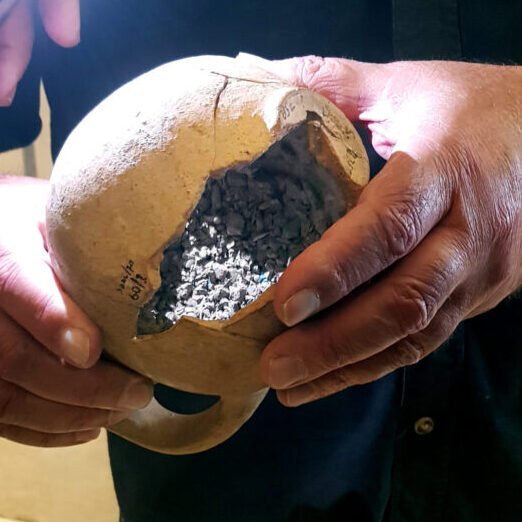
Biblical jug with raw silver from the time of King David
The jar you see in front of you was unearthed in the ancient biblical city of Eshtamoa (Israel) and according to some researchers dates back to the time of King David (10th century BC). The greyish material you see inside is raw silver which was commonly used before coins were invented. The Bible tells us that after David defeated the Amalekites he sent some of the plunder to the elders of Judah, saying “Here is a gift for you from the plunder of the Lord’s enemies” (1Samuel 30:26). Amongst them were the elders of Eshtamoa – the same city in which this jar was discovered. Since the location and age of the jar corresponds to that of the biblical story, it’s possible that this could be the plunder mentioned in the Bible. This simple jar therefore, might contain more than just raw silver, but a “hello” from King David 3000 years ago!
Rosh Hashana, the biblical Jewish New Year is described in the Torah (Lev. 23:24) as a “zikhron teruah”: A time of “blowing [of the shofar] of remembrance”.
WHAT are we to “remember” and WHY do we blow the Shofar (ram’s horn)? Rosh Hashana not only marks the biblical New Year and therefore new beginnings, but is also the anniversary of the Creation, culminating in the creation of humankind – Adam & Eve- on the sixth day. On Rosh Hashana we crown and proclaim God as king of the universe and remind ourselves that the Creation was an act of the purest love, that we are all created equal as beloved children of God, and that we are called to emulate God by going go out into the world and doing acts of loving kindness in our everyday lives – both at home and at work.
Why do we blow the shofar?
The “shofar (ram’s horn) of remembrance” (Lev. 23:24) reminds us of God’s servant Abraham, the depth of his faith with the sacrifice of Issac, and how he took the ram instead when the angel stopped his hand. Abraham was chosen by God not only because of his faith, but more importantly because of his quality of “chesed”- loving kindness towards all human beings, including strangers- and willingness to act on their behalf. This is demonstrated in the story of Sodom and Gemorrah and how he pleads with God not to destroy the evil pagan inhabitants.
In closing, may this Rosh Hashana, Day of Remembrance and Jewish New Year, be one of true remembrance of the blowing of the Shofar ram’s horn and even greater resolve to emulate Abraham in spreading peace and loving kindness in our homes, communities, and the world.
What kind of father was Joseph and what kind of home did Jesus grow up in?
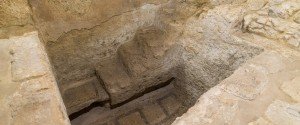
Mikve, St. Joseph church
To answer this let’s have a closer look at what Joseph did for a living in Nazareth: In Matthew 13:55 we read in reference to Jesus: “Is this not the carpenter’s son?” In Greek the word used (and translated as “carpenter”) is actually “tectonus”, which means “builder”. In other words, Joseph had a building business of sorts, working not only in wood but also in stone. Indeed, building in the Holy Land has always been largely out of stone since wood is scarce (Solomon ordered Cedars from Hiram in Lebanon) and to this day old Nazareth is built out stone. Now, all you guys know that construction is a tough business that can go either way financially, belly up or success if you’re good at what you do.
Mary’s private mikve ritual bath Now here’s some ARCHAEOLOGICAL evidence that suggests that Joseph (who we know so little about from the Bible) was indeed quite a successful builder: That he made a good living, and provided a really nice home for his family. Above is a photo of a bonafide “mikve” (Jewish ritual bath) taken by a friend of mine, Dr. Tom Winger (whose pastors tour I guided). It was discovered beneath the Church of St. Joseph in Nazareth which is built over the traditional home of Joseph and Mary, where Jesus grew up.
To be kosher, the MIKVE ritual bath has to be cut out of solid rock (not constructed), hold a minimum of 40 seah (~40 gallons), and be fed by “living water” (non-drawn water) – usually rain water from the roof. Here’s the thing: Such elaborate Jewish ritual baths are quite expensive and are therefore generally built by a Jewish community at the local synagogue. Only the wealthy could afford to install a private one in their home. This is evidenced by a 2000 year old mikve ritual bath we found in a 7,000 square foot Herodian style mansion in Jerusalem from the time of the Temple.
Biblical home and family life
So what kind of father was Joseph and what kind of home did Jesus grow up in? Joseph appears to have been quite a guy: The biblical role model of a father and “family man” who worked hard, made a good living, and provided a beautiful home for his wife Mary, who wouldn’t have had to “shlep” to the local synagogue on a cold rainy winter night to use the public mikve ritual bath. This and more… as a successful builder Joseph also had the means, coupled with the right priorities, to provide Jesus with a top notch biblical education: Jesus is called “Rabbi” in the Bible, which means he probably studied in a yeshiva (rabbinical school) but that’s another story.
Leaving Jerusalem, we follow the main road to Emmaus, a biblical Jewish town that became known as Nicopolis in the late Roman Byzantine period. Here passed Joshua, the Maccabees, Crusades, & Jesus who, according to the New Testament Book of Luke, appeared after Calvary and the Resurrection.
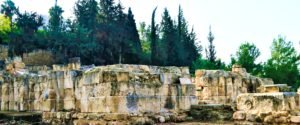
Emmaus: Byzantine & Crusader church
A real biblical place…
The rich history of Emmaus is marked by the passage of many conquerors and famous people. The Book of Joshua tells how the sun and moon stood still over the adjacent Ayalon Valley when Joshua marched with the Israelites on Gibeon- north of Jerusalem – some 3200 years ago. In 165 BC, Judah Maccabee, one of the important heroes of Hanukkah, won an important victory nearby against the Greek troops of Nicanor. This opened the way to Jerusalem and made it possible for the Jews to purify the Temple which had been desecrated by the Greeks and re-establish the Divine Service, a victory celebrated by the feast of Hannukah every year.
The place where Jesus broke bread
By the time of Jesus’ public ministry (~30 AD) Emmaus had become a simple village. It was here, after the Resurrection, that Jesus appears to his disciples, who recognized Him in the breaking of bread (Lk. 24:13-35).
Byzantine period: Christian pilgrimage
In the 3rd century AD there was a Christian community in Emmaus and the town was given a new name, Nicopolis or City of Nike – Greek goddess of victory. During the Byzantine period (4-7 centuries) Emmaus Nicopolis became an important Christian administrative center and a basilica to serve Christian pilgrims was built at the traditional site of Jesus’ apparition.
Crusades
Byzantine churches which had earlier been destroyed were built by the Crusaders in the 12th century, and subsequently destroyed after the Arab reconquest of the Holy Land. Impressive remains are still visible.
Modern times
It was only in 1878, at the initiative of Miriam of Bethlehem, that the Carmelite convent of Bethlehem acquired the site. Since then, it has once again become a place of pilgrimage.
Excavations
Excavations in 1880, 1924, and recent years unearthed the remains of two imposing Byzantine basilicas with beautiful mosaics, a baptistery, and the ruins of a Crusader church.
Gospel according to Luke 24,13-35
“That very day two of them were going to a village named Emmaus, about a hundred and sixty stadia from Jerusalem, and talking with each other about all these things that had happened. While they were talking and discussing together, Jesus himself drew near and went with them. But their eyes were kept from recognizing him… So he went in to stay with them. When he was at table with them, he took the bread and blessed, and broke it, and gave it to them. And their eyes were opened and they recognized him; and he vanished out of their sight…”
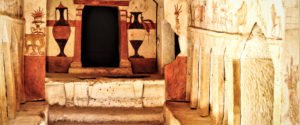
The Sidonian Tomb discovered at the biblical city of Beit Guvrin – Maresha in the foothills of Judea southwest of Jerusalem, is an extraordinary rock-carved and hand-painted burial complex. It belonged to Phoenician traders from Sidon that settled in southern Judea after Alexander the Great’s conquests (332 BC).
Sidonian tomb
Explore a biblical city…
There aren’t remains of too many ancient cities that one can wander through and see how people lived over 2000 years ago! Well, Beit Guvrin / Maresha, situated in the foot hills of Judea is one of them. Today we explore the colorful mausoleum of a wealthy family of traders that came from Sidon (Lebanon today) and settled here in the 2-3rd century BC.
Why situated here?
Situated at the foot of the Judean Hills, between the Mediterranean coast and the mountains, Maresha was on an important trade route connecting Hebron and the port city of Ashkelon.
Greek speaking settlers from Sidon
Sidon was and still is an important seaport- just north of Israel, on the Lebanon coast. In bible times it was home to Phonecian traders that plied the Mediterranean establishing trading posts as far away as Spain and the Atlantic Ocean. They also settled here. From the time of Alexander the Great (3rd C. BCE) it became Greek speaking and as pagans they worshipped the Greek gods.
Burial caves with colorful paintings
The soft local chalk allowed the locals at Maresha to carve out extensive subterranean tombs and even underground workshops. The colorful wall paintings depict, plants and animals from everyday life such as a lion, snake, fox while some of them are mythological. Musicians accompany the funeral train. They are short, pudgy, and appear to be somewhat jovial types. One of the instruments is a double reed flute that can still be found in the region. A loving and kind person
Apollophanes: Leader of the local Sidonian community
In the tomb depicted here archaeologists found an inscription mentioning the wealthy head of the local Sidonian community buried here. His name was Apolophanes son of Sesmaios, leader of the Sidonian community in Maresha. On a human note, the inscription goes on to say that Apolphanes was a kind, loving, generous, and well liked person. And here we are remembering him over 2000 years later! A name and memory worth more than a person’s weight in gold – can anyone wish for more?
Tel Aviv, at the heart of modern Israel, was founded north of Jaffa in 1909 by Zionist Jewish pioneers who believed in the biblical return to Zion. The name Tel Aviv is taken from Ezekiel’s vision of the Valley of Dry Bones. Tel Aviv is also known as the White City, referring to over 4000 buildings built in the Bauhaus or International Style by Jewish architects and refuges that fled Hitler’s Germany in the 1930’s. Tel Aviv is a UNESCO World Heritage Site.
View Tel Aviv from Old Jaffa
Tel Aviv panorama
We are overlooking the busy, bustling, modern day metropolis of Tel Aviv from Old Jaffa. Locals call Tel Aviv the “Big Orange” named after the famous Jaffa oranges that still grow in area. In fact, you might have seen them from the airplane as you approached for landing. We can see ultra modern office buildings going up everywhere, in an assortment of interesting shapes and there are beautiful new garden condos lining the water front promenade.
Sand dune beginnings outside of Jaffa
Would you believe that in 1909, when Tel Aviv was founded outside the walls of old Jaffa, there was little more than sand dunes, sand flies, and malaria here. Today, Tel Aviv is a vibrant cosmopolitan city at the heart of the most dynamic economy in the Middle East. And this without one drop of crude oil below the surface, though there have been recent discoveries of natural gas. Tel Aviv also has the world’s largest exchange for polished diamonds and a world leader in high tech start-up companies. Tel Aviv is also the music and theater center of Israel. And all of this for a country just over 65 years old, that has faced an uphill battle for survival from the beginning.
How was Tel Aviv founded
Let’s examine how Tel Aviv got here- how it started. It’s a story that goes back a little over a hundred years ago- to the turn of the 20th century. There was an awakening of Jewish nationalism calling for a real practical return to Zion. We were always used to praying for the return to Zion, and still do. But this was different. This was a pro-active movement. A movement that said “just do it” and God will help and protect us along the way.
Back then, a handful of Jewish people arrived here by steamer from Europe, to the port of ancient biblical Jaffa. They came, not as tourists, but as pioneers; to fulfill a crazy dream – to rebuild the ancient biblical Jewish homeland. They were fired by a longing, an inner call for the Return to Zion.
The reality they met when they got off the boat was very different. Back in those days, before WWI, Palestine was just emerging from a deep slumber. It was a disease ridden backwater of the Ottoman Empire with malaria, glaucoma, no electricity, no running water, and an often hostile and a deeply corrupt local officials.
Nevertheless, overcoming hardship, these early Jewish settlers managed to purchase some land – sand dunes just outside the ancient walled city of Jaffa- the area in the foreground of the photograph, plan a new neighborhood, build their homes, and set down roots. The original neighborhood still exists, with gabled roof homes, narrow cobblestone streets, and even an old synagogue.
Ezekiel’s Valley of Dry Bones
What motivated them to come and invest their last pennies in an insecure place? No hard-nosed investment counselor would have suggested sinking time and money into such a troubled region!
The answer is linked to the origin and meaning of “Tel Aviv”. The name “Tel Aviv” comes from the prophet Ezekiel’s “Valley of Dry Bones” vision (Ezekiel 37:1-14) and is the place in his imagination that the vision unfolds. The story goes like this: In the year 586 B.C., the great Babylonian empire of Mesopotamia ( the area of Iraq today) was on the war path and conquered Jerusalem, laying waste the great Temple of Solomon. The Jews were taken into captivity and exiled to Babylon (southern Iraq today). There was a great sense of despair among the Jewish people. Even loss of faith. Existential questions were raised. How could our god Yahweh allow his House to be destroyed, his chosen people to be scattered? What about His promise to Abraham? Does God go back on his promises?
It was the prophet Ezekiel, the man of God, the man of faith who was exiled along with his people that rose to the occasion. He had a vision- the Valley of Dry Bones, reminding us that God’s promises are eternal. That there will come a time when the dry exiled bones of the nation of Israel would come to life again in His promised land.
Return to Zion
And so, when a handful of young Zionist families came from Europe as pioneers, fulfilling the biblical belief in the Return to Zion, bought some desolate sand dunes north of Jaffa to build their homes, they were like dreamers. They acted on vision. They sensed that they were active instruments of God in the building of a dream, the fulfillment of prophecy. In their minds they weren’t just building another neighborhood, but were laying the foundations for a new city. They dared dream that their little neighborhood would grow to become the infrastructure for the return and resurrection of the dry exiled bones of the Jewish people to their ancient home. Like the ripples that emanate from dropping a pebble into a pond, their tiny initiative – would grow into something greater than themselves.
Tel Aviv: “Hill of Spring”
And why is the name of the place that Ezekiel had his Vision of the Dry Bones called “Tel Aviv”? The name Tel Aviv is Hebrew, literally meaning “Hill of Spring”. Spring symbolizes rebirth and therefore encapsulates the whole message of the Vision of the Dry Bones- the promise of rebirth and new life that comes from the Lord.
Bauhaus White City
With the rise of Hitler many German Jewish architects fled and settled in Tel Aviv, bringing with them the Bauhaus or International Style of building. Today there are over 4000 buildings in this style in Tel Aviv, collectively known as the White City, and UNESCO has declared the ensemble a World Heritage Site.
The beautiful and pastoral Sea of Galilee with its majestic dates & palm groves, and fed by the Jordan River, is a favorite among Holy Land pilgrims. Jesus settled here in the Jewish fishing town of Capernaum after leaving Nazareth.
Sea of Galilee
Soulful sea…
Ahh, yes, the Sea of Galilee… You may have sailed the “Seven Seas”, but if you haven’t sailed on the Sea of Galilee… What can I say- this one’s got SOUL brother! No wonder so many miracles happened in this spot and that it’s a favorite, not only among millions of pilgrims, but with locals too- finding in this place where G-d speaks, peace, tranquility, and inspiration.
Kinneret or Sea of the Harp
Actually, in Hebrew, the language of Scripture, the lake is called the “Sea of Kinneret”, which means “Sea of the Harp”. Look at the map on the blog site and you’ll see that it indeed has the shape of a harp, which is a reminder of the Harp of David. Indeed, according to biblical tradition the Messiah will come out of the House of David. No wonder, in the New Testament, Jesus leaves his hometown of Nazareth and comes down to the Sea of Galilee, where he spends the last three years of his life: He settles in the ancient lakeside Jewish town of Capernaum where he centers his public ministry as a roaming rabbi – teacher – miracle-worker.
Jordan River
The Sea of Galilee is a actually a freshwater lake, fed by the Jordan River on the northern end. The lake is bigger than most people imagine: 25 km X 15 km (~15 X 7 miles) and 50 meters (~150 feet) deep. It’s part of the Great Rift Valley extending from Turkey to East Africa and is about 200 meters (over 600 feet) below sea level. No wonder it’s so warm, lush, and brimming with tropical and subtropical vegetation: Bananas, Mango, Avocado, Bougainvillea.
Dates & Date Palms
At the southern end of the Sea of Galilee, where the Jordan River flows out of the lake and winds its way south to the Dead Sea, are beautiful date palm groves, famous since Bible times. The dates were brought to the Holy Temple in Jerusalem as a First Fruits offering and are today exported all over the world.
Sail on the Sea of Galilee
I invite you to join me in discovering the delight of the Sea of Galilee. Together we’ll set set sail aboard one of the wooden boats pictured on this page, cut the motor, and just listen to the silence, the wind, and gentle lapping of the water. Reflecting on the meaning of this very special place, that has little changed since Bible times, you may find yourself breaking out your Bible, singing a hymn, and even kicking up your heels in joy!