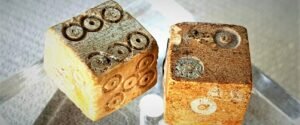
Archaeological excavations in Jerusalem don’t cease to bring the Bible alive! Here are a couple of 2000 year old stone dice from the 1st century AD when the Jewish Holy Temple, originally built by king Solomon, was still standing- before the Romans burned it down. These may be the very kind used by the Roman soldiers who cast dice to see who would get the clothes of Jesus after he was crucified. Biblical reference: “After they had crucified him, they [the Roman soldiers] determined who would get his clothes by throwing dice for them (Mt 27:35 King James)
Doric capital found from Solomon’s Portico in the Holy Temple of Jerusalem…
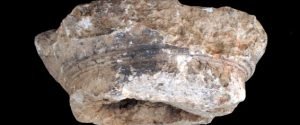
Discovered! Doric capital from Solomon’s Portico in the Holy Temple of Jerusalem (credit: Vladimir Naychin)
Whether celebrating Passover or Easter, the Paschal lamb sacrifice is a central theme. Here is a recent find from where it all happened 2000 years ago – the Holy Temple itself, that stood on Mount Moriah in Jerusalem! Discovered was a 28” diameter Doric capital from one of the monumental columns of Solomon’s Portico – a 1500 foot long covered colonnade porch that extended along the eastern side of the Temple Mount, and one of four such porticos that enclosed the Outer Court of the Temple. The beautifully preserved Doric capital, the first find of its kind, was sifted from rubble destructively dug up near the El Aksa mosque by the local Moslem religious authorities and dumped outside Jerusalem’s Old City walls.
Doric capital from the Parthenon temple in Athens (450 BC)
Strength, Simplicity, & Unity
The Doric capital is composed of a flared circle at the top (known as the “echinus) which transitions downward to three concentric circles (called “annulets”). It was topped by a square slab called the “abacus” upon which the colonnaded portico roof would sit. The characteristic unity and simplicity of the Doric style can be noticed in the 5th century BC Parthenon in Athens. Doric columns were fluted and tapered, and considered to be the stronger among the three Greek orders of columns (Doric, Ionic, Corinthian). For this reason, they would be used in the lower level of multistory structures such as the Roman Colosseum, an amphitheater built by the emperor Vespasian and his son Titus, who destroyed the Holy Temple in Jerusalem just a few years earlier.
Athens Doric portico
About Solomon’s Portico
We read about Solomon’s Portico, where the Doric capital came from, in the writings of Josephus Flavius, a kohen (Jewish priest, descendant of Aaron) who witnessed the destruction of the Temple by Titus the Roman in 70 CE: And now it was that the temple [in Jerusalem] was finished. So, when the people saw that the workmen were unemployed, who were above eighteen thousand, and that they, receiving no wages, were in want… they persuaded him [Agrippa, grandson of King Herod] to rebuild the eastern porticos… This was the work of king Solomon, who first of all built the entire temple. (Josephus, Antiquities 20,9,7)
Model of the Holy Temple in Jerusalem (destroyed by Titus in 70 AD) with colonnade porticos of outer court
Double row of columns – 42 feet high!
Josephus continues: The porticos [around the Outer Court of the Temple] were double [in width], and the pillars belonging to them were twenty-five cubits in height [~42 feet], and supported the portico. These pillars were of one entire stone each of them, and that stone was white marble; and the roofs [of the portico] were adorned with cedar, curiously graven. The natural magnificence, and excellent polish, and the harmony of the joints in these cloisters, afforded a prospect that was quite remarkable. (Josephus, Wars 5,5,2)
Jesus in Solomon’s Portico on Hanukkah Then came the Festival of Dedication [Hanukkah] at Jerusalem. It was winter and Jesus was in the temple courts walking in Solomon’s Portico. (Jn. 10:22-23)
Peter with lame beggar in Solomon’s Portico While the [healed lame] man held on to Peter and John,all the people were astonished and came running to them in the place called Solomon’s Portico. (Acts 3:11)
Apostles gather in Solomon’s Portico The apostles performed many signs and wonders among the people. And all the believers used to meet together in Solomon’s Portico. (Acts 5:12)
Come to Israel and discover more about Solomon’s Portico
I invite you to join me here in Israel. Tour with family, friends, or put together a group and save. We’ll experience a 3-D living color Bible. See the Doric capital from Solomon’s Portico and other authentic finds from the Holy Temple. We can even sift earth in search of artifacts and learn more about biblical Israel.
Discovered: Golden Bell from the High Priest robe in Jerusalem’s Holy Temple
Gold bell from hem of Jewish High Priest’s robe. (credit City of David & Israel Antiquities Authority)
Is it possible to hear an actual musical note from bible times? Well, here’s an incredible find that sheds light (photo credit City of David & Israel Antiquities Authority): The Bible and book of Psalms are full of references to musical sounds. We recall Miriam, the sister of Moses, who after the miraculous crossing of the Red Sea “took a timbrel in her hand… and sang” (Ex. 25:20) and David who would “take up his “kinor” (harp) and bring relief and solace to King Saul (1Sam.16:23). Ongoing archaeological excavations around Jerusalem in recent years have revealed so much to us from Bible times. In 2011, an actual golden bell, probably one of 72 that were sewn on the hem of the sky-blue “mei-eel” or robe, one of the eight vestments worn by the High Priest in the Holy Temple. We read about the golden bells in the book of Exodus:
Exodus 28:33-35
“And upon the hem of it thou shall make… a golden bell and a pomegranate, a golden bell and a pomegranate, upon the hem of the robe round about. It shall be on Aaron when he performs the service, and its sound shall be heard when he enters the Holy before the Lord and when he leaves, so that he will not die.” (Ex. 28:33-35)
Call to prayer and repentance
The Sages explain that the whole people gave themselves up to prayer and repentance, while the High Priest stepped into the Holy of Holies to officiate in their name. It was therefore most appropriate that they should all know the moment when he entered the Holy of Holies.
Discovery
The gold bell was discovered in an underground drainage channel dating from the time of Christ, when the Temple was still standing. The finely engraved, pomegranate shaped, gold bell was sealed all around, so it was x-rayed, and archaeologists could see the 4mm clapper, still intact. It was suspended on a gold wire, striking the bell precisely in the middle. The amazing thing is that the bell still rings! So it was sent to a music lab where it was sampled, amplified 72 times, and played back in rapid succession, the way the bells would have sounded on the hem of the vestments when the High Priest walked barefoot into the Holy of Holies of the Temple itself. Only the High Priest could enter the Holy of Holies, and then only on Yom Kippur – the Day of Atonement – the holiest day in the Jewish calendar, but his movements could, thanks to the bells, be heard..
Why the note “B”?
It’s interesting to note that the frequency of the bell is 240 hz, which corresponds closely to the musical note B. But why “B”? In the ancient world, the note B represented the planet Saturn or Saturday, which was the 7th day of the week. For the Jews of course this is the Sabbath day, known as “Shabbat” in Hebrew. Indeed the word for bell in Hebrew, “pa’amon” has a numeric value of 240. So the ringing of the bells on the hem of the High Priest sounded out a central tenant and message of our biblical faith: The Sabbath, the celebration of life, and belief in a premeditated act of Creation by a Creator.
Visit Israel & see the golden bell remains of the Holy Temple in Jerusalem I invite you to join me here in Israel and experience a 3-D living color Bible- a blessing without measure! Shalom! Shalom! Zack Shavin, Jerusalem
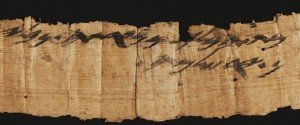
This ancient 7th century BC papyrus is the first mention of Jerusalem in Hebrew outside the Bible (photo Israel Antiquities Authority)
Papyrus mention of Jerusalem (Israel Antiquities Authority)
Jerusalem is indeed famous, mentioned over 800 times in the Bible. But do we have any ancient historical documents that connect the Jews with Jerusalem OUTSIDE of the Bible? The answer is YES! The Israel Antiquities Authority has recently recovered a 2700 year old, 7th century B.C. papyrus fragment written in ancient Hebrew script, language of the Jewish people and Old Testament, and contains the earliest Hebrew mention of Jerusalem outside the Bible.
Royal Wine shipment
The papyrus is part of a royal bill of lading (official shipping document) of jars of wine sent from Na’aratah (vic. Jericho – see Josh. 16:7) to JERUSALEM, capital of the kingdom of Judea.The papyrus fragment, miraculously preserved by the dry Judean desert around the Dead Sea, was sent to the world famous Weizmann Institute for testing and was dated to the 7th century B.C.- over 2600 years old! The period of the papyrus document is that of the Temple of Solomon, the kings of Judaea (probably Josiah, who instituted a religious reform), and the prophet Jeremiah. It predates the 586 BC Babylonian conquest of Judea and subsequent exile of the Jewish people to Babylon.For comparison sake, the papyrus document predates the Dead Sea Scrolls (2nd century BC), by over 500 years!
Jerusalem papyrus (Israel Antiquities Authority)
Hebrew text
Note the last word on left in the 2nd line (yellow): “Yerushalima” (to Jerusalem):
מא]מת. המלך. מנערתה. נבלים. יין. ירשלמה]
Transliteration: [me-a]mat. ha-melekh. me-Na’artah. nevelim. ya’yin. Yerushalima.
Translation: [From the] king’s maidservant, from Na?arat, jars of wine, to Jerusalem
Come to Israel and let me show you this 2,700 year old papyrus from the 7th century BC – the first mention of Jerusalem in Hebrew outside the Bible – as well as the famed Dead Sea Scrolls and other biblical sites. Shalom!!! Zack Shavin
The 2000 year old Arch of Titus celebrates Roman victory over Judea, depicting soldiers carrying Jerusalem Temple treasures into Rome.
With the recent UNESCO (United Nations Educational, Scientific, and Cultural Organization!!!) vote denying any Jewish connection to the Western Wall and Temple Mount (Mount Moriah) where the Mosque of Omar and El Aksa Mosques stand today, I’d like to suggest that the supporters of the resolution visit the Arch of Titus situated close by the Coliseum next time they are in Rome. The 2000 year old arch was built to honor Titus who laid siege to Jerusalem in the year 70 A.D. and destroyed the Jewish Holy Temple that stood on Mount Moriah.
Arch of Titus: Roman soldiers carrying the golden Menorah into Rome
Depicted on the arch are Roman soldiers carrying the Menorah (seven branched golden candelabrum) into Rome, as well as other Temple treasures such as the Golden Trumpets and Show Bread offering table which was made of acacia wood and covered with gold. The Jewish revolt against Roman tyranny and the attempt to reestablish independence broke out in Caesarea (Mediterranean coast) in 66 A.D. and ended seven years later with the fall of Masada in 73 A.D. The Western Wall is a remnant of the massive support walls that encircled and supported the Temple Mount platform and upon which the Moslems later built the Dome of the Rock mosque, also known as the Mosque of Omar.
Rosh Hashana, the biblical Jewish New Year is described in the Torah (Lev. 23:24) as a “zikhron teruah”: A time of “blowing [of the shofar] of remembrance”.
WHAT are we to “remember” and WHY do we blow the Shofar (ram’s horn)? Rosh Hashana not only marks the biblical New Year and therefore new beginnings, but is also the anniversary of the Creation, culminating in the creation of humankind – Adam & Eve- on the sixth day. On Rosh Hashana we crown and proclaim God as king of the universe and remind ourselves that the Creation was an act of the purest love, that we are all created equal as beloved children of God, and that we are called to emulate God by going go out into the world and doing acts of loving kindness in our everyday lives – both at home and at work.
Why do we blow the shofar?
The “shofar (ram’s horn) of remembrance” (Lev. 23:24) reminds us of God’s servant Abraham, the depth of his faith with the sacrifice of Issac, and how he took the ram instead when the angel stopped his hand. Abraham was chosen by God not only because of his faith, but more importantly because of his quality of “chesed”- loving kindness towards all human beings, including strangers- and willingness to act on their behalf. This is demonstrated in the story of Sodom and Gemorrah and how he pleads with God not to destroy the evil pagan inhabitants.
In closing, may this Rosh Hashana, Day of Remembrance and Jewish New Year, be one of true remembrance of the blowing of the Shofar ram’s horn and even greater resolve to emulate Abraham in spreading peace and loving kindness in our homes, communities, and the world.
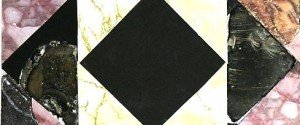
2000 year old marble floor tiles from the Holy Temple on Mount Moriah in Jerusalem brought to light.
Marble floor tile from Holy Temple Jerusalem (credit Zachi Dvira Temple Mount Sifting Project)
For the first time in history, actual decorative elements from the Holy Temple in Jerusalem have been brought to light! Exquisite marble floor tiles, made with meticulously cut stones of different colors – yellow, black, red, purple, white, and more have been recently recovered and pieced together, giving us insight into the great beauty of the Holy Temple of the Jews that stood on Mount Moriah and was destroyed by Titus the Roman in the year 70 AD. Archaeologists have so far been able to identify seven distinct floor tile patterns.
Marble floor tile from Holy Temple Jerusalem (credit Zachi Dvira)
We read about the impressive Temple floor tiles in various literary sources: Josephus Flavius, the Jewish historian who actually served as a priest in the Jerusalem Temple wrote (Jewish Wars V,5,2), “Open courts were laid with stones of various colors.” In the Babylonian Talmud (Baba Bathra 4a) we read, “It used to be said, He who has not seen the Temple of Herod [in Jerusalem] as never seen a beautiful building. Of what did he build it? Rabbah said: Of yellow and white marble. Some say, of blue, yellow, and white marble.”
Marble floor tile from Holy Temple Jerusalem (credit Zachi Dvira)
Hundreds of colorful marble floor tile pieces have been discovered in a major sifting project undertaken by Israel Antiquities authority after Moslem religious authorities on the Temple Mount (where the golden dome Mosque of Omar and El Aksa mosques are located) illegally removed rubble beneath Mount Moriah, without conducting a proper archaeological excavation. The floor tiles were probably part of the monumental subterranean passageway built by Herod the Great that led up to the Courtyard of the Gentiles on the Temple Mount, and was used by pilgrims – such as Jesus, Mary, & Joseph – when they came to Jerusalem for Passover.
Visit Israel & see remains of the Holy Temple in Jerusalem
I invite you to join me here in Israel and experience a 3-D living color Bible- a blessing without measure! We’ll learn about the Holy Temple that stood on Mount Moriah, visit the Temple Mount excavations, and even help wash the archaeological remains in search of artifacts.
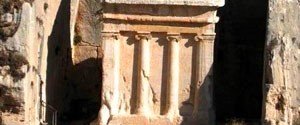
Walking in the Kidron Valley at the foot of the Mount of Olives in Jerusalem we come across the monumental rock carved Tomb of Zechariah son of Jehoiada the High Priest.
Tomb of Zechariah son of Jehoiada the High Priest who served in Solomon’s Temple in Jerusalem
Zechariah murdered:
Zechariah the priest, who lived in Jerusalem at the end of the 9th century BC, dared admonish Joash, king of Judah, for being unfaithful to YHWH and allowing Baal worship to be reintroduced into the Holy Temple in Jerusalem.
Actually, Joash in the early part of his 40 year reign instituted a wide religious reform, ridding the Temple of Baal worship, but later on lapsed into idolatry. Zechariah the priest spoke out against this and was subsequently murdered by stoning in the courtyard of the Temple of Solomon. We read about it in 2 Chronicles 24:21ff:
Here’s what the Bible’s got to say: “Then the Spirit of God came on Zechariah son of Jehoiada the priest. He stood before the people and said, “This is what God says: ‘Why do you disobey the Lord’s commands? You will not prosper. Because you have forsaken the Lord, he has forsaken you. But they plotted against him, and by order of the king [Joash] they stoned him to death in the courtyard of the Lord’s temple.”
Joash had been saved as an infant by Zechariah’s father Jehoiada: King Joash apparently did not remember, or did not want to remember, the kindness Zechariah’s father – Jehoiada the High Priest – had shown him when he was an infant: Jehoiada saved Joash from his evil grandmother, Athaliah, daughter of of Ahab and Jezebel: After her son Ahaziah, king of Judea, was killed at Megiddo, she began killing her dead son’s children to assure her position as ruler over Judea! When Joash turned seven, Jehoiada the High Priest brought him out of hiding as the legitimate heir to the throne, descendant of the House of David, and anointed him king over Judea (see II Chronicles 22:11 & II Chronicles 24:21).
Egyptian influence
The the monumental rock carved tomb is from the 2nd century BC and has a pyramid shape, showing Egyptian influence.
Leaving Jerusalem, we follow the main road to Emmaus, a biblical Jewish town that became known as Nicopolis in the late Roman Byzantine period. Here passed Joshua, the Maccabees, Crusades, & Jesus who, according to the New Testament Book of Luke, appeared after Calvary and the Resurrection.
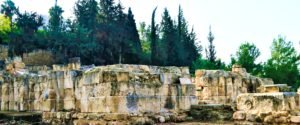
Emmaus: Byzantine & Crusader church
A real biblical place…
The rich history of Emmaus is marked by the passage of many conquerors and famous people. The Book of Joshua tells how the sun and moon stood still over the adjacent Ayalon Valley when Joshua marched with the Israelites on Gibeon- north of Jerusalem – some 3200 years ago. In 165 BC, Judah Maccabee, one of the important heroes of Hanukkah, won an important victory nearby against the Greek troops of Nicanor. This opened the way to Jerusalem and made it possible for the Jews to purify the Temple which had been desecrated by the Greeks and re-establish the Divine Service, a victory celebrated by the feast of Hannukah every year.
The place where Jesus broke bread
By the time of Jesus’ public ministry (~30 AD) Emmaus had become a simple village. It was here, after the Resurrection, that Jesus appears to his disciples, who recognized Him in the breaking of bread (Lk. 24:13-35).
Byzantine period: Christian pilgrimage
In the 3rd century AD there was a Christian community in Emmaus and the town was given a new name, Nicopolis or City of Nike – Greek goddess of victory. During the Byzantine period (4-7 centuries) Emmaus Nicopolis became an important Christian administrative center and a basilica to serve Christian pilgrims was built at the traditional site of Jesus’ apparition.
Crusades
Byzantine churches which had earlier been destroyed were built by the Crusaders in the 12th century, and subsequently destroyed after the Arab reconquest of the Holy Land. Impressive remains are still visible.
Modern times
It was only in 1878, at the initiative of Miriam of Bethlehem, that the Carmelite convent of Bethlehem acquired the site. Since then, it has once again become a place of pilgrimage.
Excavations
Excavations in 1880, 1924, and recent years unearthed the remains of two imposing Byzantine basilicas with beautiful mosaics, a baptistery, and the ruins of a Crusader church.
Gospel according to Luke 24,13-35
“That very day two of them were going to a village named Emmaus, about a hundred and sixty stadia from Jerusalem, and talking with each other about all these things that had happened. While they were talking and discussing together, Jesus himself drew near and went with them. But their eyes were kept from recognizing him… So he went in to stay with them. When he was at table with them, he took the bread and blessed, and broke it, and gave it to them. And their eyes were opened and they recognized him; and he vanished out of their sight…”
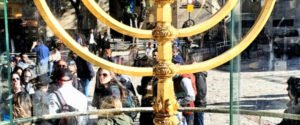
The seven branch Menorah or Golden Lampstand, a reminder of the seven days of Creation, was cast from one talent of gold and stood in the Tabernacle of Moses and later in Solomon’s Temple in Jerusalem.
Golden Menorah
Divinely inspired
Did you know that the Menorah or Golden Lampstand, as it is translated in many Bibles, was specially designed by God? It’s a “divine design” by the Master Creator of the universe and, following God’s instructions detailed in the Bible (Exodus 25:31-40). It had seven branches and was cast in one piece using 1 talent of pure gold: “Make a lampstand of pure gold. Hammer out its base and shaft, and make its flowerlike cups, buds and blossoms of one piece with them… A talent of pure gold is to be used for the lampstand and all these accessories.”
Where was the Menorah placed?
God proscribed that it should be placed in the Tabernacle – the portable temple – that the Israelites carried through the wilderness for 40 years, on the way from Egypt to the Promised Land. Later on it was places in the Holy Temple that king Solomon built on Mount Moriah in Jerusalem (“Solomon’s Temple”). Throughout history the Jewish people have incorporated it into synagogue design and today it is the symbol of the modern state of Israel- it’s that important! Let’s look at the meaning of the word Menorah. In most bibles it is translated as Golden Candlestick or Candelabrum. What is so special about it? Why is it holy and what does it represent?
How much is one talent of gold?
One talent (kikar in Hebrew) is worth 3000 shekels. There are various evaluations of how much a shekel weighs, but if we take an average of 12 grams/ shekel X 3000 = 3.6 kilos. At a gold value of $1,108 per troy ounce = approximately $128,000!
Why the number seven?
The seven branches or lights are not by coincidence. In the Bible, the number seven reminds us of the seven days of creation in the biblical book of Genesis. Seven in Hebrew- sheva – means fullness- to be totally filled and fulfilled. It was indeed what God felt when he finished his masterwork of Creation and His jewel-in-the- crown: Us! And then he “rested” on the seventh day- i.e. kicked back and said “Wow!”. He had humanity to lavish his love upon, with the hope, since we were created in His image, that we’d turn around and to the same with each other in fulfilling the commandment “love your neighbor as yourself”.
What is the significance of the lights?
The name “menorah” comes from the Hebrew root meaning “light” . So the emphasis is not on the actual candle holder but on the subject of “light” within the biblical creation story of the seven days. Indeed, the first thing God did – on the 1st day was to create light- “Let there be light!”. What kind of light was it? Not necessarily a physical light, but more importantly the Divine Light – which increased day by day throughout the Creation story as God planted himself in every nook and cranny of Creation- until it was All Pervading- as represented by the Menorah. But God’s menorah is not candles or oil lamps- it is people. Indeed in the book of Proverbs it says, “The spark, the lamp, of God (i.e. the divine light) is the soul of man.”. In other words, we, each human being, is a divine light, carrying the divine spark that was created on the 1st day. Through our actions we can choose to increase the divine light within ourselves or diminish it. The choice is ours, in the way we conduct our daily lives.
What happened to the original Menorah?
When Titus burned down the Holy Temple in Jerusalem he looted it and removed the Golden Lampstand. It was then paraded through the streets of Rome along with Jewish prisoners of war as depicted on the Arch of Titus near the Colosseum in Rome. His father Vespasian deposited the Menorah together with the other booty in the special temple which he erected after the Jewish Revolt against Rome in the years 66-73 AD. (Josephus Flavius: Wars 1:148-50) The subsequent fate of the Golden Lampstand is uncertain. It was probably melted down since it was made with 1 talent (3.6 kg) of pure gold.