Tag: Jerusalem

  • Western Wall

    Western Wall

    Western (Wailing) Wall

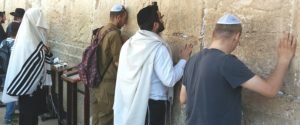
    Touch biblical Jerusalem! Israel’s Western Wall or Wailing Wall, built by King Herod, supports the huge Temple Mount platform over Mount Moriah where Solomon’s Temple stood. Ask Zack Shavin about visiting and even celebrating your Bar Mitzvah or Bat Mitzvah there!

    Biblical Jerusalem
    Imagine a piece of ancient Jerusalem, so authentic, so well preserved, that what you see today is exactly what was seen by the local people and tens of thousands of Passover pilgrims that made their way up to the great Holy Temple 2000 years ago! It is called in Hebrew the Kotel Ma-aravi or Western Wall, and is a perfectly preserved remnant of the massive outer retainer walls that encompassed the Temple itself. Originally over 1500 feet long and 100 feet high, the Western Wall was one of four incredibly massive walls that not only protected the Temple, but also supported a massive platform which covered an area equivalent to 15 football fields and upon which the 200 foot high marble and gold Temple stood.

    Wasn’t the Temple destroyed by the Romans?
    Indeed, the Temple building itself – considered one of the wonders of the ancient world – was destroyed by the Romans in the year 70 A.D. But the platform upon which the Temple stood, covering an area of 15 football fields, and the outer retainer walls, were preserved. It was just too massive to totally demolish. The smallest of the stones in the Western Wall weigh 3 tons each, the largest about 500 tons- as much as 10 fully loaded semi-trailer trucks!

    Why do we pray at the Western Wall? Why this spot?
    It is important to understand, that this place is Mount Moriahitself, where Abraham brought Isaac, almost 4000 years ago. About 1000 years after Abraham, King Solomon was given the privilege of building the Temple here, permanently replacing the desert Tabernacle. The Bible tells us that upon completing the Temple, ruach elohim- the spirit of God- filled the House. Otherwise it would have remained just a beautiful man-made building.

    Shekinah: Divine Presence
    In other words, the Shekinah- the Divine Presence- is intimately associated with the area. Indeed, the Temple is called “Beit HaMikdash” in Hebrew, which means “House of Holiness”. God is pure holiness; divine holiness came to rest here. God, Yahweh- HaShem- chose this place- it is unique in all the world! Two thousand years ago Jewish people prayed at the Temple itself. Today, the gold-domed Mosque of Omar stands over the spot and is closed to non-Moslems for prayer purposes. While we cannot pray on the Temple Mount itself, we can do so at the Western Wall. There we literally touch a remnant of the Temple complex and connect with our roots, faith, and heritage.
  • Abraham Overlook

    Abraham Overlook

    Abraham & Isaac Overlook

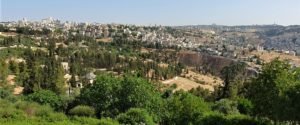
    Imagine opening the Bible here in Israel and standing at the very place where a biblical event unfolded! Today we are at the Abraham & Isaac Overlook in Jerusalem. Here Abraham and Isaac first beheld Moriah – place of the Sacrifice or Binding of Isaac, following a three day journey from Beersheba. Later King Solomon built Solomon’s Temple on Mount Moriah itself.

    Jerusalem panorama
    Jerusalem panorama

    View of Moriah 
    This particular spot on the southern end of Jerusalem is called by locals the Tayelet, which means in Hebrew “promenade”. I like to call it the Abraham and Isaac Overlook overlook since it’s where they beheld Jerusalem and Mount Moriah some 4000 years ago! I’ve been bringing groups here for years- to read and reflect on Abraham’s journey with Isaac from Beersheba, where they lived, to this very spot. God had called Abraham to sacrifice his son Isaac and with a heavy but obedient heart sets out on the three day journey, without of course letting Isaac in on the details of exactly what was happening.

    Beersheba to Moriah
    Here is what the Bible says: “Some time later God tested Abraham. He said to him, Abraham! Here I am, he replied. Then God said, Take your son, your only son, whom you love—Isaac—and go to the region of Moriah. Sacrifice him there as a burnt offering on a mountain I will show you. Early the next morning Abraham got up and loaded his donkey. He took with him two of his servants and his son Isaac. When he had cut enough wood for the burnt offering, he set out for the place God had told him about. On the third day Abraham looked up and saw the place in the distance.” (Gen. 22:1-4)

    Where is the lamb?
    Upon arrival here, at this southern overlook of Jerusalem, Abraham leaves his servants behind to keep an eye on the camp, while he continues with Isaac on into Jerusalem itself and on up Mount Moriah. He tells them that he was going “yonder” with Isaac to worship and would be back soon. It’s about a 45 minute brisk walk from where we are standing at the Abraham & Isaac overlook to Moriah. On the way Abe & Isaac obviously had time to talk a bit. Isaac, who was younger, stronger, and therefore carrying the wood for the sacrifice, gets to thinking. He turns to his father, saying, hey dad, haven’t we forgotten something? “Where’s the lamb”? Abraham replies, “God will provide.” The rest is history: The angel stops Abraham’s hand as he raised the knife after binding is son on the altar, indeed providing the lamb:

    Binding of Isaac
    Here is what happens next: “When they reached the place God had told him about, Abraham built an altar there and arranged the wood on it. He bound his son Isaac and laid him on the altar, on top of the wood. Then he reached out his hand and took the knife to slay his son. But the angel of the Lord called out to him from heaven, Abraham! Abraham! Here I am, he replied.Do not lay a hand on the boy, he said. Do not do anything to him. Now I know that you fear God, because you have not withheld from me your son, your only son. (Genesis 22:10-12)

    Abraham takes the ram instead
    Abraham looked up and there in a thicket he saw a ram caught by its horns. He went over and took the ram and sacrificed it as a burnt offering instead of his son.” (Genesis 22:13)

    Solomon’s Temple
    Almost 1,000 years later, King Solomon builds the Jerusalem Temple on the very spot on Mount Moriah: “Then Solomon began to build the temple of the Lord in Jerusalem on Mount Moriah, where the Lord had appeared to his father David. It was on the threshing floor of Araunah the Jebusite, the place provided by David.” (2Chronicles 3:1)